

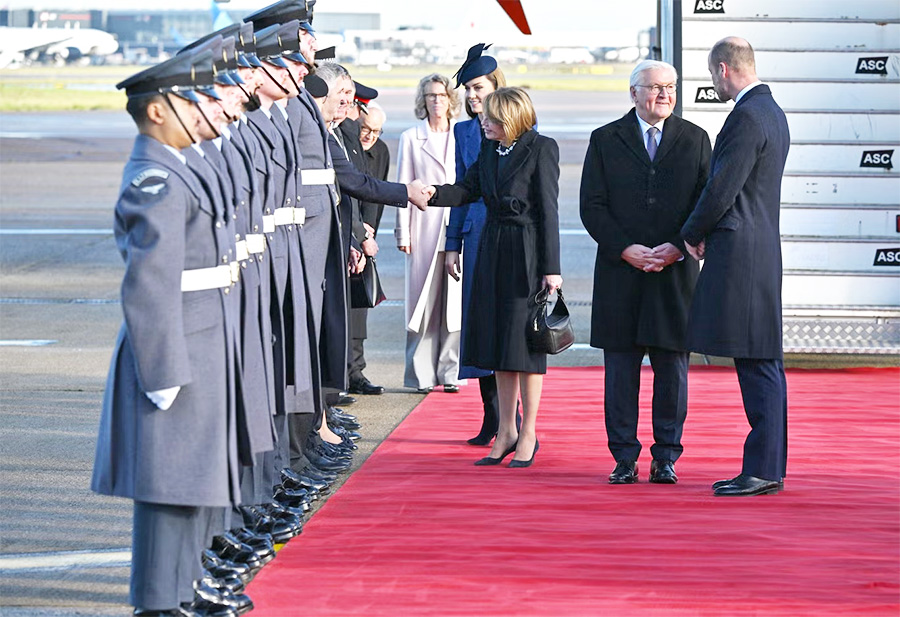
Their Majesties King Charles, Queen Camilla, Prince and Princess of Wales welcome the President and First Lady of Germany in a Regal Ceremony of Tradition and Renewal
Today, as the first rays gilded the battlements, the United Kingdom extended its most hallowed hand of welcome to President Frank-Walter Steinmeier and First Lady Elke Büdenbender of Germany—their three-day state visit marking the first such honor bestowed upon a German head of state in 27 years. Amidst the flutter of Union Jacks and Tricolores, this procession was no mere diplomatic overture; it was a symphony of reconciliation, a bridge forged from the fires of shared yesteryears toward the uncharted horizons of tomorrow.
The morning’s overture commenced at the threshold of the realm itself: London Heathrow Airport, where the hum of jet engines yielded to the solemn cadence of arrival. There, beneath a sky streaked with the promise of winter’s clarity, the Prince and Princess of Wales—William and Catherine, resplendent in hues of cerulean that echoed the boundless sea between allies—stood as emissaries of the Crown. It was Catherine who first extended her grace, introducing a cadre of key dignitaries to Frau Büdenbender: the poised figures of the Lord Chamberlain, the Master of the Household, and senior protocol officers from the Foreign, Commonwealth & Development Office, each a silent sentinel of tradition. Prince William, ever the steadfast anchor, engaged President Steinmeier in animated discourse on the enduring threads of partnership, their words weaving the personal with the profound. This was no perfunctory greeting; it was the spark of kinship, a moment where the weight of crowns met the warmth of conversation, as the party embarked on an eight-mile journey to Windsor’s embrace.
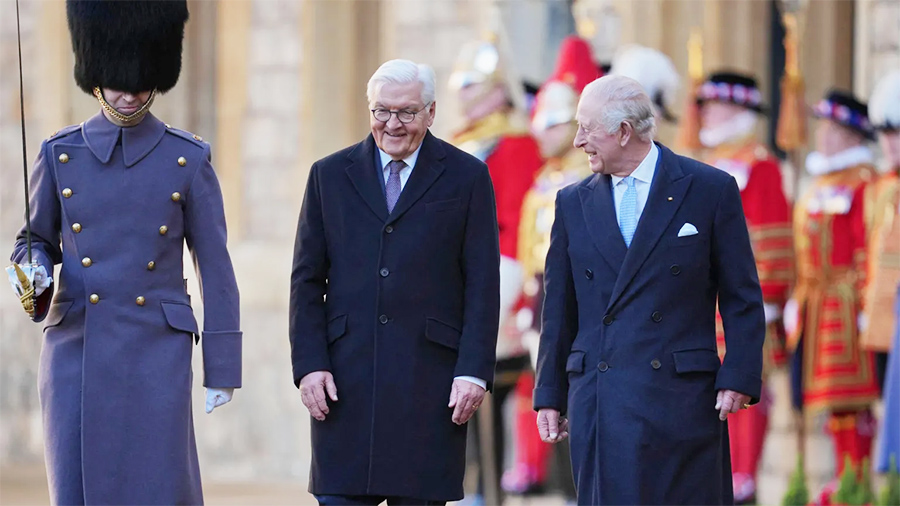 From the tarmac, the cortege glided toward destiny, the modern roar of engines giving way to the timeless poetry of equine splendor. At Datchet Road, the royal dais awaited, a crimson carpet unfurled like a banner of brotherhood. King Charles III and Queen Camilla, their presence a beacon of regal fortitude amid the King’s ongoing health journey, greeted their guests with open arms and heartfelt candor. “It’s so wonderful, Your Majesty, to see you again,” the President proclaimed, his voice laced with genuine mirth as he clasped the King’s hand, a gesture that dissolved formality into familiarity. A 41-gun royal salute thundered from the East Lawn of Windsor Home Park, its echoes mingling with the chimes of the Tower of London, while the strains of the German national anthem soared skyward, harmonized by the British, in a duet of mutual reverence.
Long before the winter sun crested the horizon, they began to gather: families wrapped in scarves the colour of Union Jacks and German tricolours, children perched on parents’ shoulders clutching homemade banners, pensioners who had risen in the dark with thermos flasks and folding chairs. By eight o’clock the pavements along the Long Walk, Datchet Road, and Windsor High Street were a living ribbon of warmth. They had waited hours, some since dawn, yet the cold could not dampen the electricity in the air. When the first distant drumbeat of the procession rolled toward them, a spontaneous roar rose from thousands of throats, a wave of pure, unscripted joy that seemed to lift the very frost from the ground.
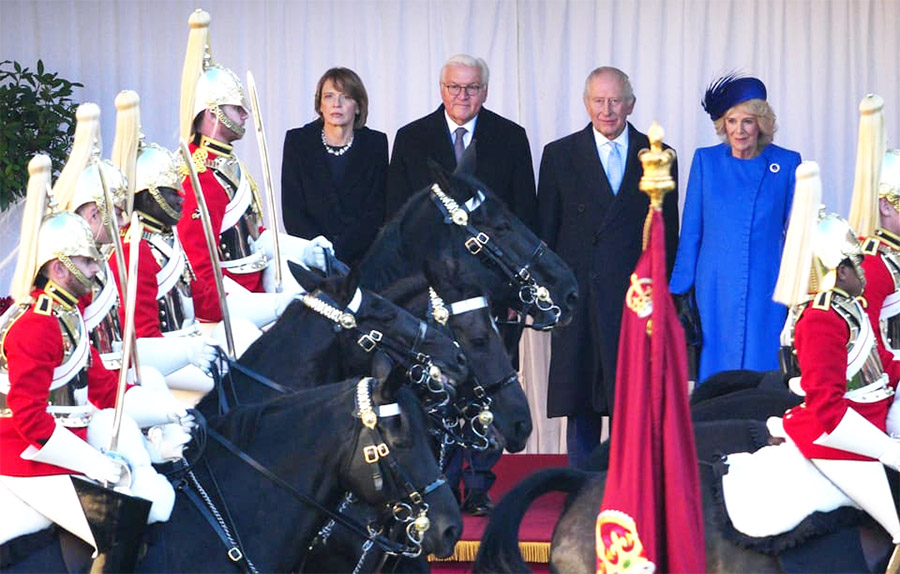 And then, the procession—a vision of equestrian elegance that transported onlookers across centuries. At its fore rode the Household Cavalry’s Sovereign’s Escort, a contingent of the Life Guards, their scarlet tunics ablaze against the winter pallor, plumed helmets nodding like crests of ancient oaks. Mounted on immaculately groomed Irish chargers—noble steeds whose lineage traces to the verdant fields of Ireland—these guardians embodied the unyielding valor of the realm. Over 150 such horses, part of a tri-service array exceeding 850 personnel from the Royal Navy, Royal Marines, British Army, and Royal Air Force, lined the thoroughfares, their flanks gleaming under Union and German banners. The escort’s precision was poetry in motion: swords at salute, boots in thunderous unison, they flanked the Australian State Coach with unwavering vigilance. This opulent carriage, a bicentennial gift from the Australian people to the late Queen Elizabeth II in 1988, gleamed with its mahogany panels inlaid with native timbers, Waterford crystal lanterns casting prismatic halos, and interiors of blue silk brocade that whispered of distant shores. Fitted with hydraulic stabilizers and subtle heating—a nod to contemporary comfort amid ceremonial grandeur—it bore King Charles and President Steinmeier through Windsor’s cobbled heart, past cheering throngs who waved from High Street and Park Street, their applause a chorus of collective hope.
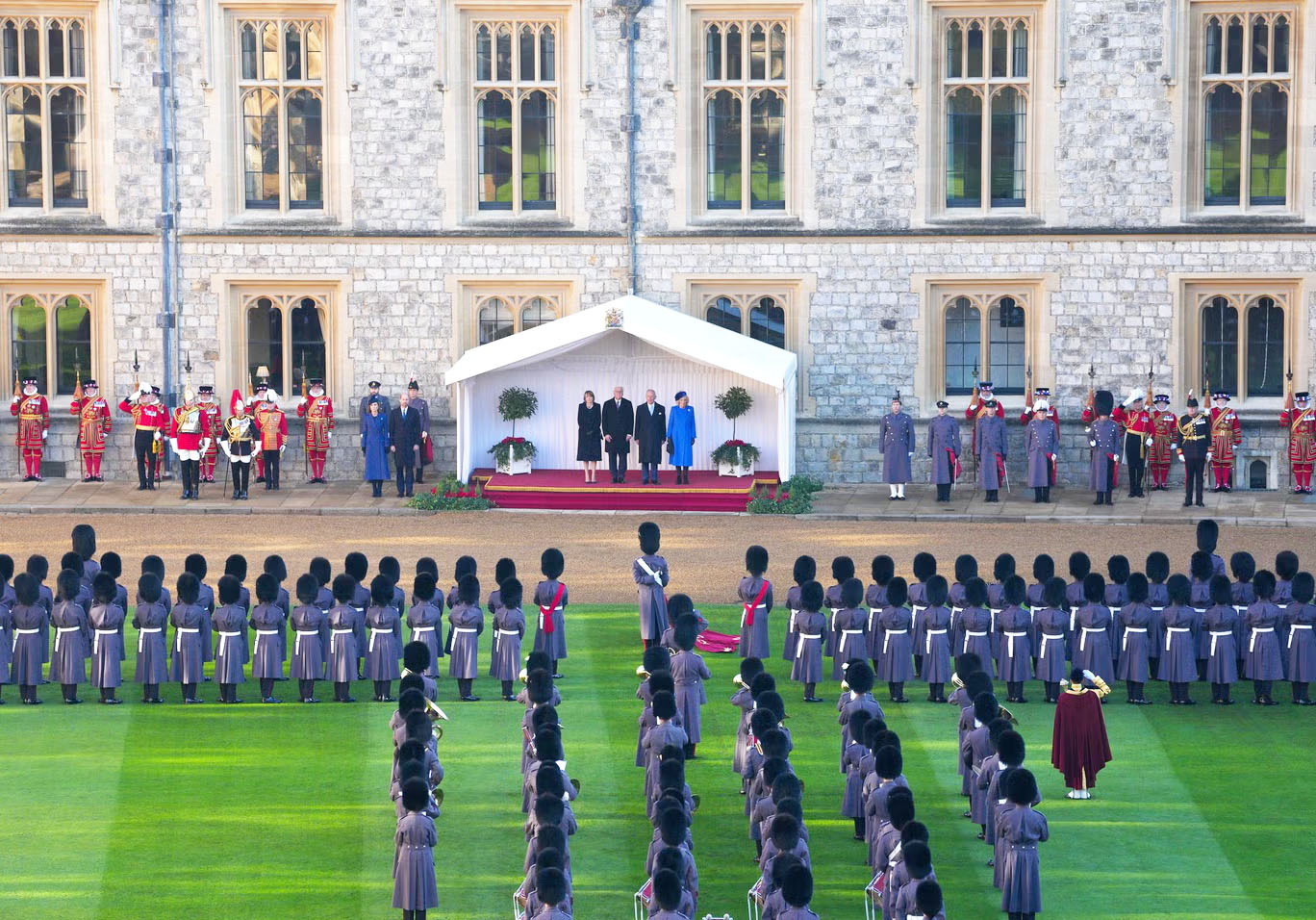
The coach’s path culminated at the George IV Gateway, where the procession swept into the Castle Quadrangle—a verdant amphitheater framed by Gothic arches and the ghosts of kings past. Here, the morning’s crescendo: a Guard of Honour drawn from the storied Grenadier Guards, the British Army’s senior infantry regiment, whose scarlet tunics and towering bearskins evoke the thunder of Waterloo, where they stood shoulder-to-shoulder with Prussian allies against Napoleon’s shadow. Forty stalwart souls formed two impeccable ranks upon the grass, their presence a living testament to resilience and resolve.
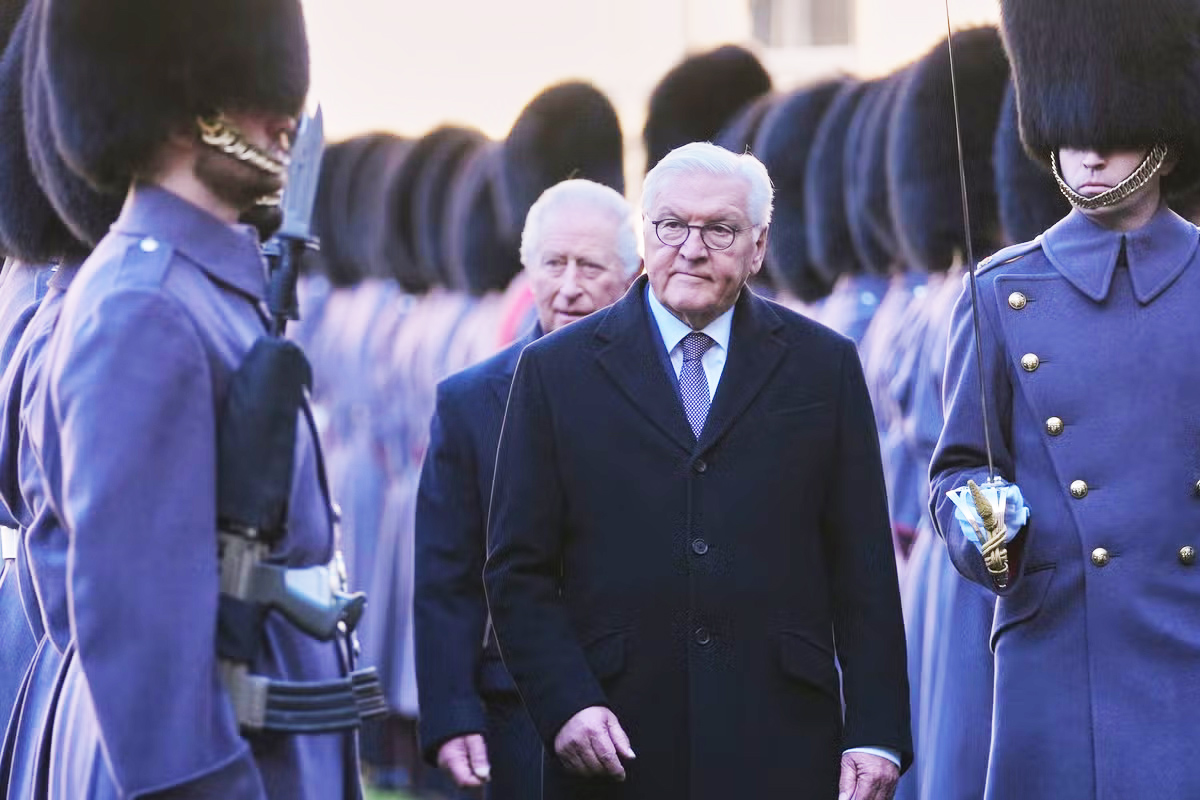 In a gesture of profound courtesy, Captain Major Ben Tracey, fluent in the tongue of Goethe, addressed the President: “Your Excellency, the Guard of Honour of the Grenadier Guards is present and ready for your inspection.” Accompanied by the King, Steinmeier passed before the lines, each soldier’s gaze a steel vow of alliance, their rifles a forest of fidelity. The inspection yielded to the Rank and March Past, a rhythmic ballet of drilled perfection, though not without a fleeting drama—a single charger from the Life Guards momentarily testing its rider’s mettle, only to be reined with the quiet command that defines true discipline. National anthems swelled once more, their notes lingering like incense over hallowed ground.
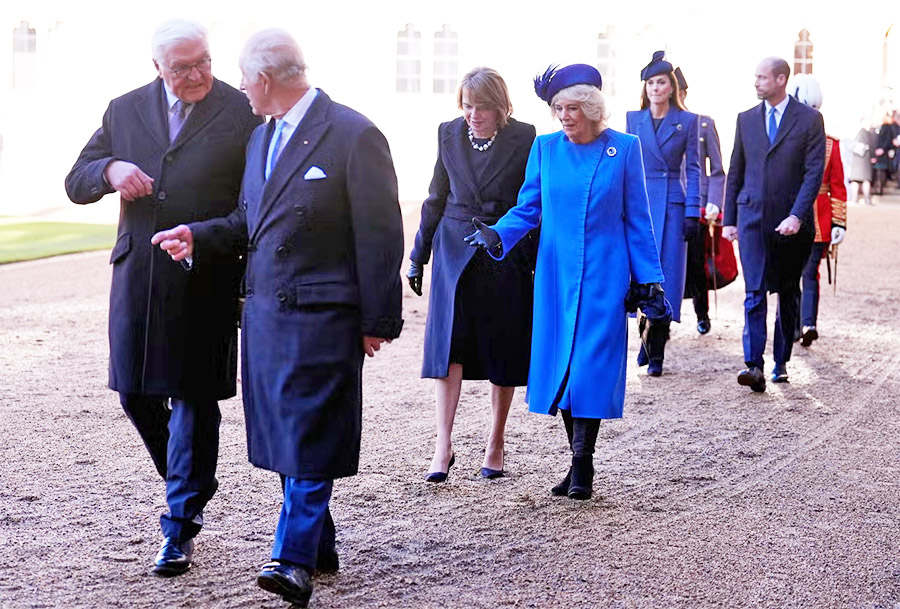
As the morning’s applause still echoed beyond the castle walls, the royal party moved into the State Apartments for a private luncheon. Around the gleaming table, twenty guests savoured dishes that blended British and German traditions, while conversation flowed with warmth and ease. His Majesty King Charles, speaking fluent German, toasted shared history—from Prince Albert’s enduring legacy to the bold new Trinity House Agreement—his words met with smiles and raised glasses. The Prince and Princess of Wales, Queen Camilla, and Elke Büdenbender joined in lively exchanges about culture, family, and the future, their laughter light and genuine. In the Green Drawing Room, treasures from the Royal Collection—exquisite porcelain, illuminated manuscripts, and historic letters—caught the winter light, quiet reminders of centuries of connection now being renewed with fresh energy.
This was friendship, kindness and diplomacy at its most human: relaxed, heartfelt, and forward-looking. Outside, the crowds still cheered; inside, friendships strengthened. In that bright December hour, Windsor Castle became more than a backdrop—it became an exciting new chapter in Anglo-German partnership, one that promises closer collaboration, greater prosperity, and lasting peace. The morning had been magnificent; the years ahead look even brighter.
