

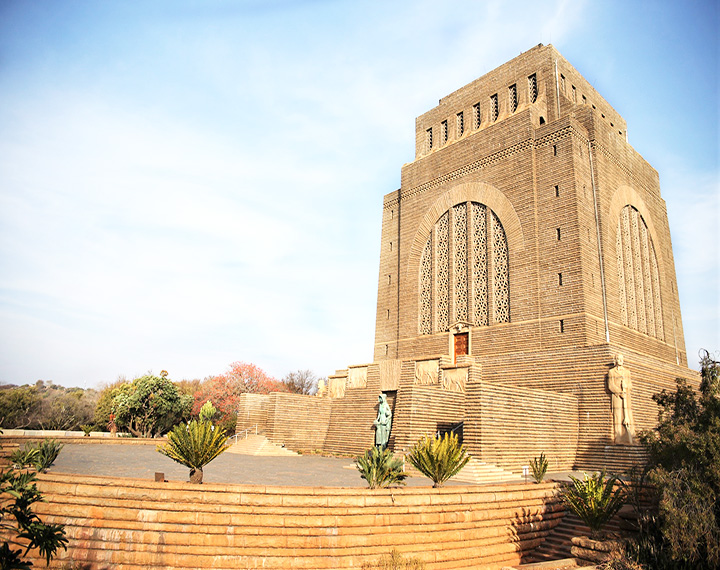
The Voortrekker Monument, situated on Monument Hill in Pretoria, stands as a monumental tribute to the Voortrekkers—Afrikaner pioneers who embarked on the Great Trek from the Cape Colony into the interior of South Africa between 1835 and 1854. Designed by architect Gerard Moerdijk, this imposing granite structure was completed in 1949 and has since become a significant cultural and historical landmark. Declared a National Heritage Site in 2011, the monument’s design and symbolism reflect the Afrikaner narrative of resilience and nation-building. Culturally, the Voortrekker Monument embodies the Afrikaner identity and their interpretation of South Africa’s history. The monument’s frieze, the largest marble frieze in the world, depicts scenes from the Great Trek and the subsequent conflicts, including the Battle of Blood River. The central hall houses a cenotaph with the inscription “Ons vir jou, Suid-Afrika” (“We for you, South Africa”), symbolizing the Voortrekkers’ dedication to their new homeland. The monument’s design incorporates elements that align with Afrikaner nationalist sentiments, reflecting the era’s political climate.
Historically, the Voortrekker Monument has been a focal point for Afrikaner heritage and identity. It commemorates the Voortrekkers’ journey and their establishment of independent republics, which later formed part of the Union of South Africa. The monument’s construction was a significant national project, funded largely by the South African government, and it has been the site of numerous commemorative events. However, it has also been a subject of controversy due to its association with Afrikaner nationalism and its portrayal of historical events from a particular perspective. This has led to ongoing debates about the monument’s role in contemporary South African society. For tourists, the Voortrekker Monument offers a profound insight into a pivotal chapter of South Africa’s history. Visitors can explore the monument’s architectural grandeur, view the extensive frieze, and learn about the Voortrekkers’ journey through exhibits and guided tours. The surrounding nature reserve provides a serene environment for reflection and appreciation of the site’s significance. While some visitors may find the monument’s historical context challenging, it remains an essential destination for those seeking to understand the complexities of South Africa’s past.



 Own or work here?