

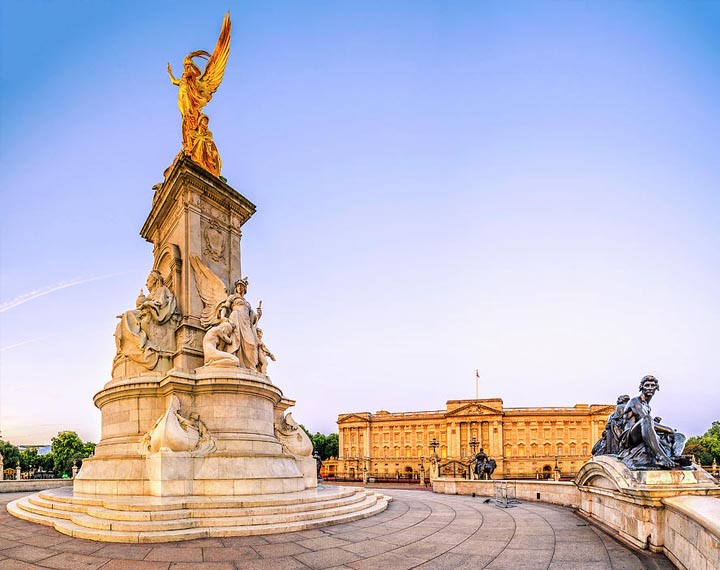
The Victoria Memorial in London stands as one of the most striking monuments to British history and imperial grandeur. Unveiled in 1911 and formally completed in 1924, it was commissioned to honor Queen Victoria, who reigned for more than six decades and presided over the vast expansion of the British Empire. Designed by Sir Aston Webb with sculptural work led by Sir Thomas Brock, the memorial sits majestically in front of Buckingham Palace, forming the centerpiece of The Mall and symbolizing the strength and continuity of the monarchy.
The monument is crafted from gleaming white Carrara marble and rises to more than 25 meters in height. At its pinnacle is a gilded statue of the Winged Victory, a radiant symbol of triumph and progress. Around its base are allegorical figures representing qualities associated with Queen Victoria’s reign—Justice, Truth, Motherhood, Constancy, and Courage—alongside maritime sculptures that reflect Britain’s naval dominance and global reach during the Victorian era.
Historically, the memorial embodies both remembrance and aspiration. It not only celebrates Queen Victoria as the longest-serving monarch of her time but also conveys the ideals of a nation that saw itself as a guiding force in the modern world. Today, the Victoria Memorial remains a powerful historic landmark, a place of state ceremony, and an enduring reminder of the Victorian age’s profound influence on Britain and beyond.



 Own or work here?