

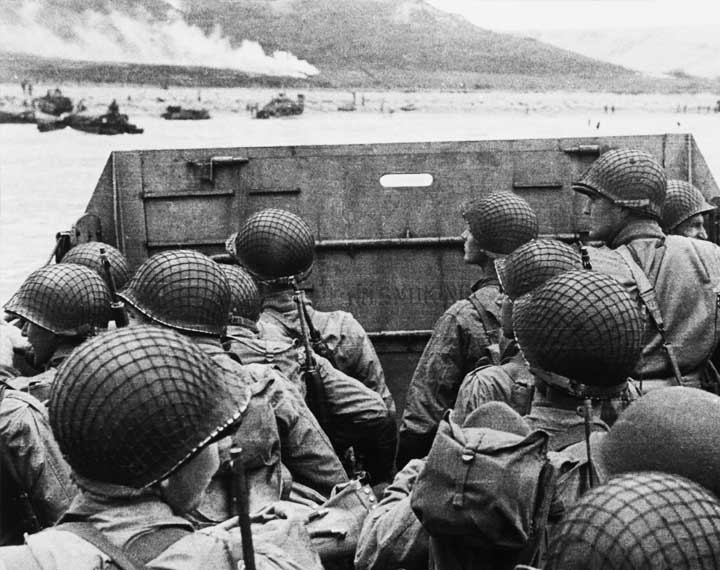
Located on the eastern shore of the base of the Cotentin Peninsula, Utah Beach was a late addition to the areas scheduled for invasion. The original plan for Operation Overlord did not call for a landing on the Cotentin, but General Dwight D. Eisenhower, supreme commander of the Allied Expeditionary Force, added it to ensure an early capture of the port of Cherbourg at the northern tip of the peninsula.
The Utah landing area was approximately 5 km (3 miles) wide and was located northwest of the Carentan estuary on sandy, duned beaches. Compared with German fortifications at Omaha Beach, the defenses at Utah, based on fixed infantry positions, were sparse because the low-lying areas immediately behind the landing area were flooded and the Germans could control the flooding with locks. Four causeways exited the beach through the flooded lowlands and severely restricted movement inland. Indeed, all land traffic was restricted to established routes, especially through the important crossroads towns of Carentan and Sainte-Mère-Église. Defenses along the causeways consisted mostly of strongpoints equipped with automatic weapons. Some 3 km (2 miles) inland were coastal and field artillery batteries. The defending forces consisted of elements of the German 709th, 243rd, and 91st infantry divisions.
The assault sectors at Utah Beach were designated (from west to east) Tare Green, Uncle Red, and Victor. The invasion was planned for Tare Green and Uncle Red, with the number 3 causeway almost in the middle of the landing area. H-Hour (that is, the time at which the first wave of landing craft would hit the beach) was scheduled for 0630 hours. The beach was to be assaulted by the U.S. 4th Infantry Division. The plan was to cross the beach and seize control of the coast roads, link up with airborne troops who were to have been dropped inland five hours earlier, and then be prepared to attack toward Cherbourg. The 8th Infantry Regiment was to attack first; supported by 32 special amphibious Sherman tanks in the first wave, it was to land opposite Les Dunes de Varreville, a well-fortified area.



 Own or work here?