

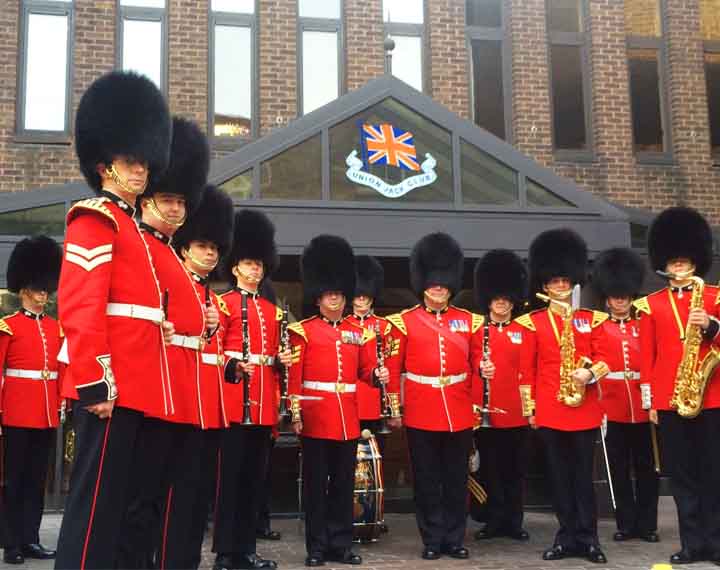
The Famous Central London Military Membership Club and Accommodation Exclusively for Serving and Veteran Enlisted Members of Her Majesty’s Armed Forces The Union Jack Club, a registered charity, was founded in 1904 and opened in 1907. We have since welcomed over 23 million people to stay. But the idea of a Club for enlisted military personnel only came from a visionary nurse named Ethel McCaul.
A visionary founder
Ethel Rosalie Ferrer McCaul (1867-1931) was a British Royal Red Cross nurse, an author and advocate for improvements in military medical practice and care. Miss McCaul distinguished herself as a front-line nurse during the South Africa Boar War campaign at the turn of the 20th Century, while at the same time becoming an outspoken critic of shortcomings in British medical practices, and a crusader for improvements.
Miss McCaul founded The Union Jack Club in London because while officers had their clubs, servicemen below commissioned rank had nowhere reputable to stay when alone, or with their families, in the nation’s capital. She was determined that they should have the opportunity to have this and to see London and all its sights, but at no more of a cost than one day’s pay.
Her tireless, skilled and highly effective fundraising efforts began in 1903 with concerts, entertainment and events throughout the country. She felt that a new club would benefit the Armed Forces and their ability to protect the Empire. The central London area of Waterloo seemed the obvious place because it was the principal railhead leading to the ports and garrisons that served the Empire. The Prince of Wales laid the foundation stone in July 1904 and as King Edward VII, officially opened the Cub in 1907 with Queen Alexandra at his side.
Built originally as a National Memorial to those who had fallen in the South African War, the original Edwardian building which was completed towards the end of 1904 and had extensive public rooms and 208 bedrooms. Over the years, particularly throughout WW1 and WW11, there was a great demand for the services provided and the need for expansion became urgent. Waterloo remained the area of choice and a families’ block in Exton Street was added to help solve the problem of the Club’s popularity. The subsequent acquisition of a separate annexe in Holmes Terrace meant that by 1939 the Club could offer 1018 beds and had become a major part of the Waterloo community, as it is today.



 Own or work here?