

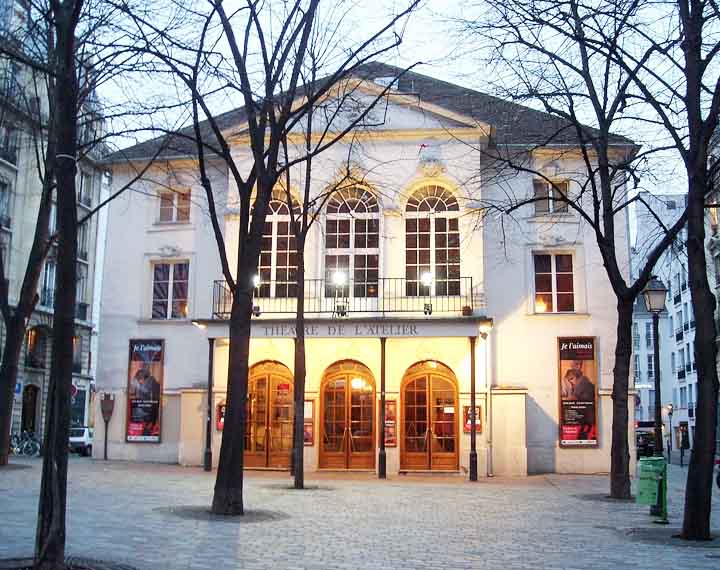
The Théâtre de l’Atelier is a well-known theater located in the 18th arrondissement of Paris, France. Théâtre de l’Atelier has a rich history dating back to its founding in 1822. Over the years, it has undergone renovations and changes, but it has maintained its status as a cultural institution.
The theater’s building has distinctive architectural features, and it is recognized for its historical significance in the Parisian theater scene.
Théâtre de l’Atelier hosts a variety of theatrical productions, including plays, dramas, comedies, and other performances. It has been a venue for both classical and contemporary works.
The theater is known for its commitment to artistic quality and has been a platform for many renowned actors, directors, and playwrights. Like many theaters in Paris, Théâtre de l’Atelier has a seating capacity that can accommodate audiences for various sizes of productions. The theater plays a significant role in the cultural life of the Montmartre neighborhood and contributes to the diversity of theatrical experiences available in Paris. Being located in a central area of Paris, the theater is easily accessible to both locals and visitors.
The programming at Théâtre de l’Atelier includes a range of genres, catering to different tastes and preferences in the world of performing arts.
As with any cultural venue, it is advisable to check the official website or contact the theater directly for the latest information on current productions, schedules, and ticketing. Théâtre de l’Atelier is part of the rich tapestry of theaters that contribute to the vibrant cultural landscape of Paris.
“Because he knew the mysterious place where Louis XVI and Marie Antoinette were buried, the actor Pierre Jacques Seveste enabled Louis XVIII to fulfill his wish to gather the illustrious remains in a funerary monument. As a reward, he received, by royal decree on June 10, 1817, the privilege for himself and his sons, for their entire lives, to ‘reign’ over the cultural life of the outskirts of Paris at that time. Seveste initiated the construction of numerous theaters, among which Montmartre was the first to come to life. It was still a small hall in the heart of the village of Orsel, on the slope of the Mont des Martyrs, and its inauguration took place on November 23, 1822.
The troupe that performed there was mainly composed of Seveste’s students, whom he exploited cheerfully, and naturally, he was reluctant to pay them. The ‘Théâtre d’élèves’ as it was commonly called then, was entirely made of wood, earning it the nickname of ‘Galère Seveste.’
With the Revolution of 1848, Montmartre was renamed Théâtre du Peuple. However, the people did not show up, and the decline in revenues forced the Seveste sons to sell the theater a year later to two actors, Libert and Gaspari, who took over its management along with that of the Théâtre des Batignolles.
In 1852, Gaspari went on to lead the Beaumarchais, leaving Libert alone at the helm. He was succeeded the following year by Alexandre-Hippolyte Chotel, also an actor.
In 1860, the commune of Montmartre, into which the village of Orsel had merged, was annexed to Paris. Montmartre became a ‘neighborhood theater,’ with most of its repertoire consisting of reviving dramas and vaudevilles previously successful in the grand theaters of the Boulevards. However, it became a breeding ground for many young actors who later became famous.”
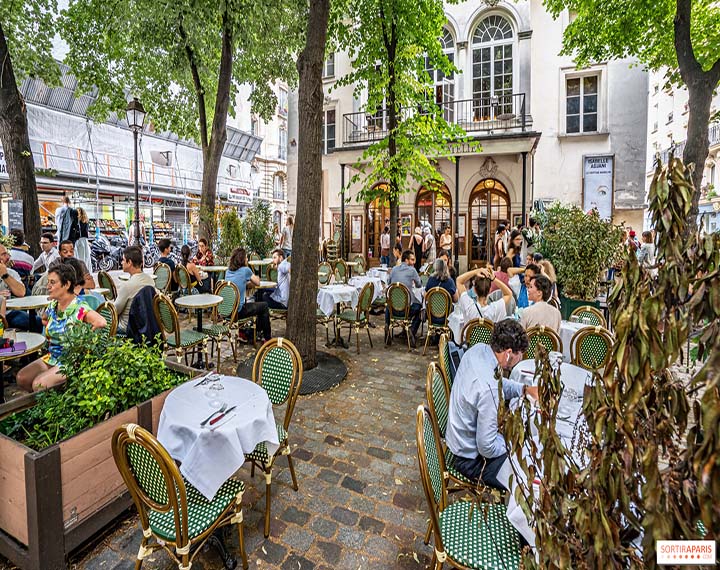
Seveste is the name of the terrace-restaurant that has taken over the Théâtre de l’Atelier square. Located in Montmartre, a stone’s throw from the Sacré Coeur, we’re off to discover the lovely bistro cuisine of brothers Alexis and Josselin Flocon.
No need to look for the restaurant’s name anywhere, Seveste can only be found on its terrace, opposite the Théâtre de l’Atelier. In fact, this neo-bistro has taken over the Place Charles Dullin in the 18th arrondissement, in the shade of its gigantic century-old lime trees. So it’s time to sit down to dinner in this charming, picturesque square that is so much a part of Paris, opposite the historic building of the former Théâtre Montmartre, designed by Pierre-Jacques Seveste in 1822 (hence the restaurant’s name, by deduction).
At Seveste, you’ll experience the hustle and bustle of Parisian life. A lively place par excellence, you’ll find yourself in front of a swarm of spectators attending one of the plays performed in one of the few 19th-century theaters still in operation. The best way to do this is to grab a bite to eat after the show and continue to enjoy this timeless setting.



 Own or work here?