

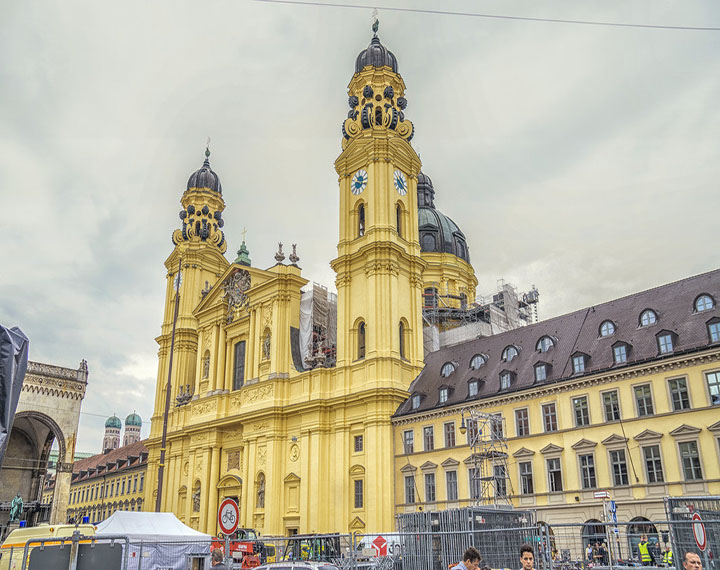
Domed baroque Catholic church with striking yellow facade & ornate white stucco interior. The Theatine Church, known as Theatinerkirche in German, is a magnificent baroque-style church located in Munich, Germany. Designed by Italian architect Agostino Barelli, construction of the church began in 1663 and was completed in 1690. It is renowned for its stunning architecture, elaborate decorations, and rich history.
The Theatine Church’s design reflects the Baroque architectural style prevalent in southern Germany during the 17th century. Its façade features a grand entrance flanked by towering columns and adorned with intricate sculptures and carvings. The church’s interior is equally impressive, with ornate stuccowork, frescoes, and gilded decorations adorning its walls and ceilings.
One of the most notable features of the Theatine Church is its striking yellow color, which sets it apart from the surrounding buildings and gives it a distinct appearance. This distinctive hue is said to have been chosen by Elector Ferdinand Maria of Bavaria to symbolize gratitude for the birth of his long-awaited heir, Prince Max Emanuel.
The Theatine Church is also home to the tombs of several members of the Bavarian royal family, including Elector Ferdinand Maria and his wife, Henriette Adelaide of Savoy. Their elaborate sarcophagi can be found in the church’s crypt, adding to its historical significance.
Today, the Theatine Church remains an important religious and cultural landmark in Munich, attracting visitors from around the world with its beauty and grandeur. Whether admired from the outside or explored within, the Theatine Church offers a glimpse into the rich artistic and architectural heritage of Bavaria.



 Own or work here?