

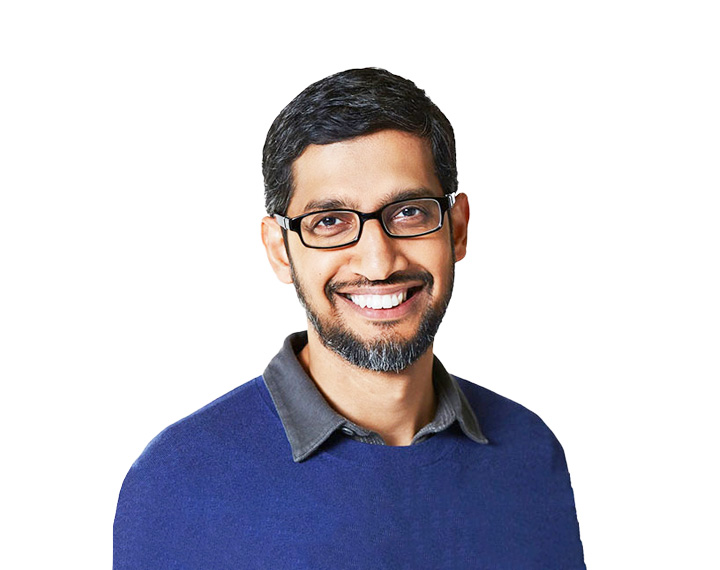
Sundar Pichai’s journey is a remarkable story of vision, resilience, and the transformative power of curiosity. Born in Madurai, India, in 1972, Sundar grew up in a modest household, where his father was an electrical engineer and his mother a stenographer. From a young age, he displayed a profound curiosity about technology and a natural aptitude for learning. Despite limited resources, Sundar’s determination to explore, understand, and innovate propelled him forward, demonstrating that talent combined with perseverance can overcome any barrier. His early fascination with engineering and problem-solving laid the foundation for a career that would change the way the world interacts with technology.
Sundar’s academic journey took him from India to the United States, where he earned an M.S. in Material Sciences and Engineering from Stanford University, followed by an MBA from the Wharton School at the University of Pennsylvania. These experiences broadened his horizons and sharpened his analytical and leadership skills, preparing him to take on challenges at the forefront of technology. His journey reflects the belief that learning is a lifelong pursuit and that every opportunity, no matter how daunting, can become a stepping stone toward greater impact.
Joining Google in 2004, Sundar quickly distinguished himself with his intelligence, humility, and vision. He played pivotal roles in the development of key products such as Google Chrome, Chrome OS, and Google Drive, transforming the way people access information and interact with technology globally. His leadership style, marked by empathy, clarity, and strategic thinking, allowed him to inspire teams to innovate at scale. Over the years, Sundar rose through the ranks, ultimately becoming CEO of Google in 2015 and later CEO of Alphabet, guiding the company through unprecedented growth and innovation while maintaining a focus on ethical and responsible technology.
Sundar Pichai’s story is not only about business success, but also about the power of purpose-driven leadership. He has championed initiatives in AI, sustainability, and accessibility, demonstrating that technology can be harnessed to improve lives worldwide. His life teaches that resilience, curiosity, and integrity are essential to achieving extraordinary impact, and that leadership is most meaningful when it uplifts and empowers others. From a small city in India to the helm of one of the world’s most influential companies, Sundar exemplifies how vision, hard work, and humility can change the world and inspire generations to dream bigger.
Alphabet’s story is one of bold vision, innovation, and the relentless pursuit of advancing human potential through technology. Born from the success of Google, Alphabet represents a commitment to exploring the frontiers of possibility, creating platforms, tools, and initiatives that touch nearly every aspect of modern life. It is a company built on curiosity, creativity, and the belief that technology can solve some of the world’s most complex challenges — from making information universally accessible to pioneering breakthroughs in artificial intelligence, healthcare, and sustainability.
From its earliest days, Alphabet has fostered a culture of experimentation and long-term thinking. By structuring itself as a parent company for a wide array of innovative ventures — including Google, Waymo, Verily, and DeepMind — Alphabet encourages bold ideas and ambitious projects to flourish while maintaining a core mission of improving lives globally. Its work demonstrates that innovation is not merely about products, but about creating systems, tools, and opportunities that empower people and communities to achieve more than they ever imagined.
Alphabet’s journey is also a story of resilience, responsibility, and purpose-driven leadership. As the company has grown into a global powerhouse, it has navigated complex challenges, market dynamics, and ethical considerations with a focus on long-term impact. Through initiatives in sustainability, AI ethics, digital accessibility, and education, Alphabet shows that technology can be a force for good — a means of connecting, enabling, and uplifting people worldwide. Its story reflects the belief that innovation should be thoughtful, human-centered, and designed to amplify positive impact.
Today, Alphabet stands as a symbol of what is possible when vision meets execution, curiosity drives experimentation, and leadership is grounded in purpose. It inspires by showing that even the most ambitious dreams can be realized when guided by a commitment to improvement, creativity, and global betterment. Alphabet’s legacy is a reminder that technology is most powerful when it elevates humanity, opens new horizons, and inspires people everywhere to imagine a better, more connected world.
Google’s story is a remarkable testament to curiosity, innovation, and the transformative power of ideas. Founded in 1998 by Larry Page and Sergey Brin in a small garage, Google began as a simple search engine with an ambitious goal: to organize the world’s information and make it universally accessible and useful. From those humble beginnings, the company has grown into one of the most influential forces in the world, shaping how billions of people learn, work, and connect every day. Google’s journey reflects the belief that even the simplest ideas, when pursued with vision and perseverance, can change the world.
From search to email, maps, cloud computing, and artificial intelligence, Google has continually expanded the ways it empowers people and organizations. Its innovations have not only transformed technology, but have also redefined how humans interact with information, enabling creativity, learning, and collaboration on an unprecedented scale. Google has consistently prioritized solving real-world problems, building tools that enhance productivity, expand knowledge, and bring people closer together. The company embodies the idea that technology, when guided by purpose, can be a powerful force for good.
Google’s growth has also been a story of resilience, learning, and responsibility. As the company has scaled to a global audience, it has navigated challenges, ethical questions, and the complexities of innovation while maintaining a commitment to transparency, safety, and positive impact. Initiatives in sustainability, AI ethics, digital accessibility, and education demonstrate Google’s mission to not just innovate, but to improve lives and create opportunities for communities around the world.
Today, Google stands as a symbol of human ingenuity and ambition. It inspires by showing that curiosity, creativity, and dedication can turn a small idea into a global movement that touches billions. Google’s story reminds us that technology is most powerful when it empowers people, solves meaningful problems, and opens doors to new possibilities. It is a story of dreaming big, working tirelessly, and building tools that not only connect the world, but uplift it.
The Googleplex is the corporate headquarters complex of Google and its parent company, Alphabet Inc. It is located at 1600 Amphitheatre Parkway in Mountain View, California. The original complex, with 2 million square feet (190,000 square meters) of office space, is the company’s second largest square footage assemblage of Google buildings, after Google’s 111 Eighth Avenue building in New York City, which the company bought in 2010. “Googleplex” is a portmanteau of Google and complex (meaning a complex of buildings) and a reference to googolplex, the name given to the large number 10
We aspire to make Google an institution that makes the world a better place. In pursuing this goal, we will always be mindful of our responsibilities to our shareholders, employees, customers and business partners. With our products, Google connects people and information all around the world for free. We are adding other powerful services such as Gmail, which provides an efficient one gigabyte Gmail account for free. We know that some people have raised privacy concerns, primarily over Gmail’s targeted ads, which could lead to negative perceptions about Google. However, we believe Gmail protects a user’s privacy. By releasing services, such as Gmail, for free, we hope to help bridge the digital divide. AdWords connects users and advertisers efficiently, helping both. AdSense helps fund a huge variety of online web sites and enables authors who could not otherwise publish. Last year we created Google Grants-a growing program in which hundreds of non-profits addressing issues, including the environment, poverty and human rights, receive free advertising. And now, we are in the process of establishing the Google Foundation. We intend to contribute significant resources to the foundation, including employee time and approximately 1% of Google’s equity and profits in some form. We hope someday this institution may eclipse Google itself in terms of overall world impact by ambitiously applying innovation and significant resources to the largest of the world’s problems.



 Own or work here?