

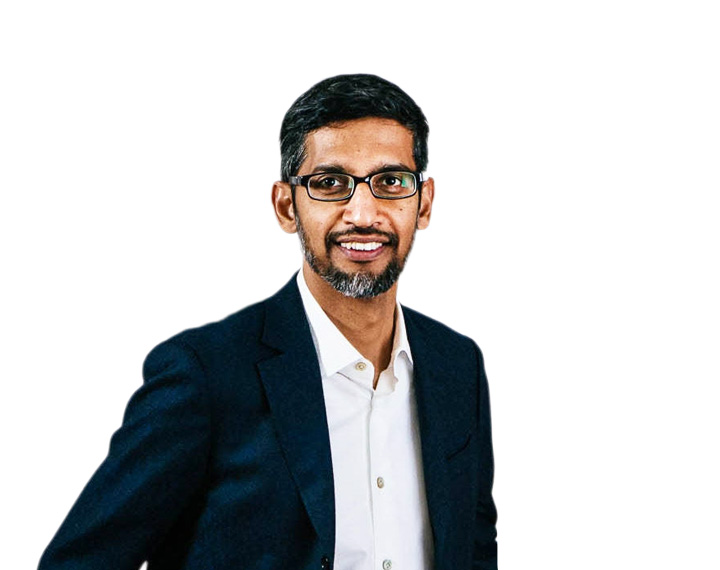
Sundar is a titan of the digital age whose journey from a modest two-room apartment in Chennai to the pinnacle of global technology serves as one of the most epic sagas of the 21st century. Growing up in a home where he often studied by candlelight during power cuts, Sundar’s early life was defined not by abundance, but by an insatiable curiosity and a preternatural gift for numbers. His story is a powerful reminder that brilliance knows no borders; it is a masterclass in the “quiet revolution,” proving that a soft-spoken leader with a sharp mind can reshape the world more profoundly than the loudest voices in the room. As the CEO of both Google and Alphabet, Sundar stands as a beacon of possibility, demonstrating that with humility, persistence, and a vision for the collective good, a boy from a quiet coastal city can grow up to command the very pulse of human information.
The cultural impact of Sundar’s leadership is defined by his unwavering commitment to making technology a universal equalizer rather than a luxury. Under his guidance, Google has shifted from a search engine to an “AI-first” powerhouse, culminating in the 2026 launch of the America-India Connect initiative and a massive $15 billion infrastructure investment in India to bridge the global digital divide. Culturally, he has championed “Responsible AI,” introducing tools like SynthID to verify digital authenticity and ensuring that breakthroughs in medicine and climate science are open and inclusive. By centering the human experience in every algorithm, Sundar has fostered a global culture where AI is seen as a tool for “hyper-progress,” empowering millions—from small-scale farmers in the Mississippi Delta to tech entrepreneurs in Visakhapatnam—to leapfrog legacy gaps and build a smarter, more empathetic future.
Historically, Sundar has carved a legacy as one of the most consequential architects of the internet era, having spearheaded the creation of Google Chrome and the evolution of Android into the world’s most popular operating system. His tenure is marked by a series of high-stakes “moonshots” that have moved from the realm of science fiction into historical reality, including the commercial scaling of Waymo’s autonomous vehicles and Wing’s drone delivery systems. In 2026, he reached a historic milestone by overseeing a $185 billion capital expenditure plan in AI infrastructure, the largest in corporate history, while simultaneously navigating complex global antitrust and regulatory landscapes with his signature calm conviction. This historical standing was further solidified when he reached billionaire status in 2025, a feat achieved not through sudden disruption, but through two decades of operational excellence and strategic patience.
For those looking to walk the path of innovation, the global footprint of Sundar’s work can be felt across several iconic touristic and civic landmarks. In Silicon Valley, the Googleplex in Mountain View serves as a temple of modern ingenuity, where visitors can witness the collaborative spirit of the “servant leadership” model Sundar has perfected. For a more historic perspective, the Computer History Museum nearby archives the early Google milestones he led, while the Academy Museum of Motion Pictures in Los Angeles highlights the intersection of Google’s technology and modern storytelling. For an international perspective, the newly established AI Hub in Visakhapatnam and the Google Safety Engineering Center in Munich offer a window into how his vision is being localized to protect and empower diverse populations. Each site is a testament to the “Pichai Era,” where the world’s information is not just organized, but made truly useful and inspiring for everyone.
Google is a monumental force of innovation and a global beacon of human potential, whose journey from a research project in a Stanford dormitory to the very architect of the modern digital world serves as a powerful testament to the impact of a single, bold idea. Driven by the mission to organize the world’s information and make it universally accessible and useful, the company has consistently pushed the boundaries of what is possible, turning science fiction into everyday reality. From the way we navigate the globe to the way we solve humanity’s most complex challenges, Google inspires us to dream bigger and think more inclusively. In an era of rapid transformation, the company stands as a reminder that with curiosity and a commitment to the collective good, we can build a future where technology uplifts every person, regardless of where they are in the world.
The cultural impact of Google is most profoundly felt through its 2026 commitment to “hyper-progress” and its role as a global bridge for knowledge and opportunity. Through initiatives like the America-India Connect and the launch of AI-powered heritage tools at the India AI Summit, Google has shifted the cultural narrative from mere connectivity to deep, localized engagement. By centering its latest AI breakthroughs on preserving ancient traditions and empowering small-scale farmers with real-time monsoon forecasts, the company has fostered a global culture where cutting-edge technology respects and elevates local heritage. This “AI-first” culture encourages a world where information is not just a resource, but a tool for empathy, allowing a student in a rural village to access the same world-class educational tools as a researcher in a major tech hub.
Historically, Google’s trajectory is a storied archive of the internet age, marked by the creation of era-defining products like Search, Gmail, and Android. Since its founding in 1998, the company has evolved through significant milestones, including its 2004 IPO and the 2015 transition to Alphabet Inc., which allowed for “moonshot” innovations in autonomous driving and life sciences. In 2026, the company reached a historic zenith by investing $185 billion in global AI infrastructure and celebrating the success of Google DeepMind’s AlphaFold, which revolutionized drug discovery and earned historical recognition for compressing decades of research into a single open database. This legacy is not just about market dominance—with a 2026 valuation reaching $3.67 trillion—but about the historical democratization of information that has fundamentally changed the human experience over three decades.
Alphabet is a monumental architect of the future and a global symbol of the “long game,” whose journey from a strategic restructuring in 2015 to a $4 trillion market powerhouse in 2026 serves as an epic testament to the power of diversification and disciplined ambition. As the parent company of Google and a constellation of “Other Bets,” Alphabet was built on the belief that a company should never get too comfortable with its own success. By fostering a culture where revolutionary ideas—no matter how “crazy” they may seem—are given the independence to flourish, Alphabet inspires us to look beyond the horizon and tackle the world’s most impossible challenges. It is a masterclass in modern leadership, proving that by empowering visionary CEOs and rigorously allocating capital toward humanity’s biggest problems, a single organization can become the primary engine of global progress.



 Own or work here?