

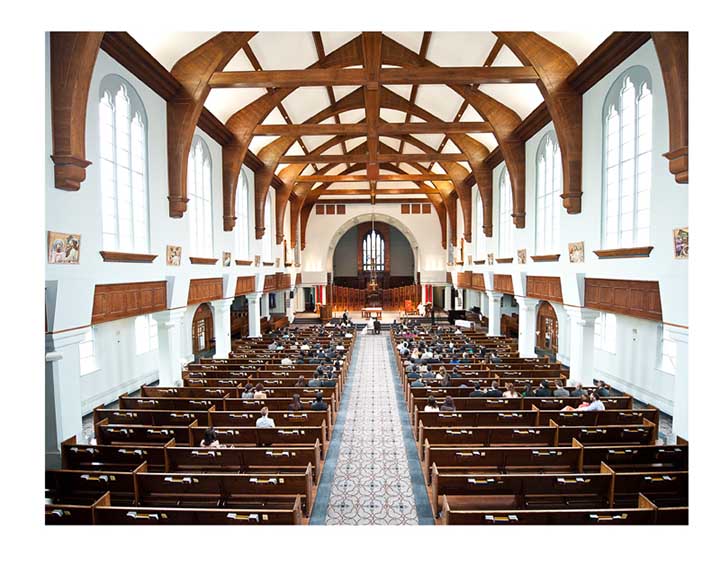
St. Mary’s Cathedral, officially known as The Cathedral of the Immaculate Conception of the Blessed Virgin Mary, is a significant Roman Catholic landmark situated at 219 18 Avenue SW in Calgary’s Mission District. It serves as the seat of the Diocese of Calgary and stands as a testament to the city’s rich religious and architectural heritage.
The origins of St. Mary’s trace back to 1889 when a sandstone church was constructed near the Elbow River on land provided by the Canadian Pacific Railway. This area, initially known as Rouleauville, was a French-speaking village established by Father Albert Lacombe in 1884. The village was annexed by Calgary in 1907, integrating the church into the expanding city. When Pope Pius X established the Diocese of Calgary in 1912, St. Mary’s was designated as its cathedral.
The current cathedral was built between 1955 and 1957, replacing the original structure. Designed by architects Maxwell Bates and Alfred Hodges, the building showcases a blend of Modern and Gothic Revival styles. Notable architectural features include a T-shaped floor plan, a 4.9-meter-tall statue of the Virgin Mary and Child sculpted by local artist Luke Lindoe, and stained glass windows crafted by Franz Mayer & Co. of Munich. The cathedral also houses four bells cast by the Paccard Foundry in France, donated in 1904 by Senator Pat Burns.



 Own or work here?