

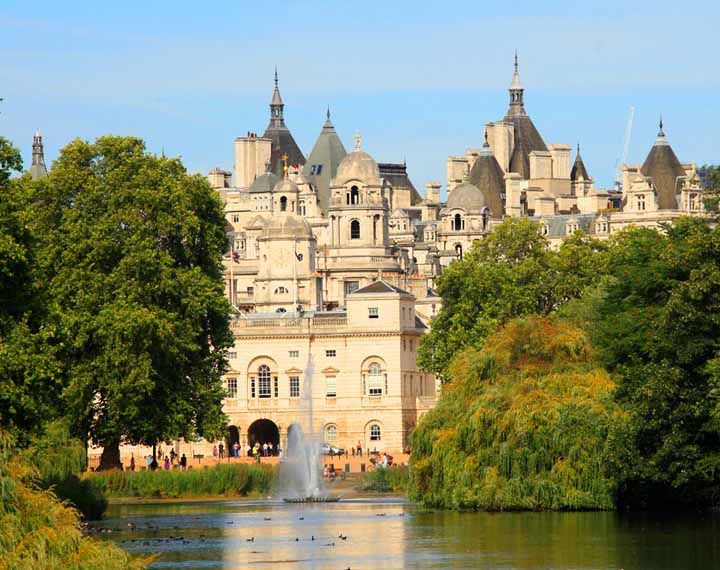
St James’s Palace is the most senior Royal Palace in the United Kingdom. Located in the City of Westminster, although no longer the principal residence of the monarch, it is the ceremonial meeting place of the Accession Council and the London residence of several minor members of the royal family
Although St. James’s Palace is the official residence of the sovereign, no monarch lives in St. James’s Palace today. However, it is still used as a ceremonial meeting place for the Accession Council, and is the residence of minor members of the royal family, like Princesses Beatrice and Eugene of York and Princess Alexandra. Prince Charles and the Duchess of Cornwall live in Clarence House, which is attached to St. James’s Palace as well.
Inside St. James’s Palace you will see four courts (now known as Ambassador’s Court, Engine Court, Friary Court and Colour Court). There is also a north gatehouse which consists of four storeys as well as two crenelated flanking octagonal towers and a central clock. The clock was added later in 1731, and was decorated with the initials “H.A.” for Henry VIII and his second wife Anne Boleyn. You can also still see Henry VIII’s royal cipher “H.R.” at the Tudor gatehouse at the south side of St. James’s Street, which is located near the original foot passages leading to Colour Court.
The palace is also part of a “sprawling complex” of different buildings which house court offices as well as official apartments. One of which includes York House, (the former residence of Prince Charles, Prince William and Prince Harry), and next door lies Lancaster House, which is used for official receptions. Also nearby is Clarence House, which was the home of the late Queen Mother.
St James’s Palace is one of London’s most historic royal residences, deeply rooted in the traditions of the British monarchy. Commissioned by King Henry VIII in the 1530s on the site of a former leper hospital dedicated to St James the Less, it became a principal royal residence for over three centuries. Monarchs such as Elizabeth I held court here, Charles I spent his final night within its walls before his execution, and it has hosted countless ceremonies, councils, and receptions of state throughout history.
Although Buckingham Palace has served as the monarch’s official residence since Queen Victoria’s reign, St James’s Palace retains its senior status and continues to play an important ceremonial role. It is the meeting place of the Accession Council, where each new monarch is formally proclaimed, and it houses offices for several members of the Royal Family. Notably, it also serves as a residence for the Princess Royal, ensuring that its historic rooms remain a living part of the royal household rather than simply a relic of the past.
Architecturally, the palace preserves much of its original Tudor character, most recognisably in its striking red-brick gatehouse with four turrets overlooking Pall Mall. The State Apartments inside contain historic interiors and significant works of art that reflect the majesty of centuries of monarchy. Today, St James’s Palace stands as a powerful symbol of continuity and tradition, bridging the grandeur of the past with the life and duties of the modern Royal Family.



 Own or work here?