
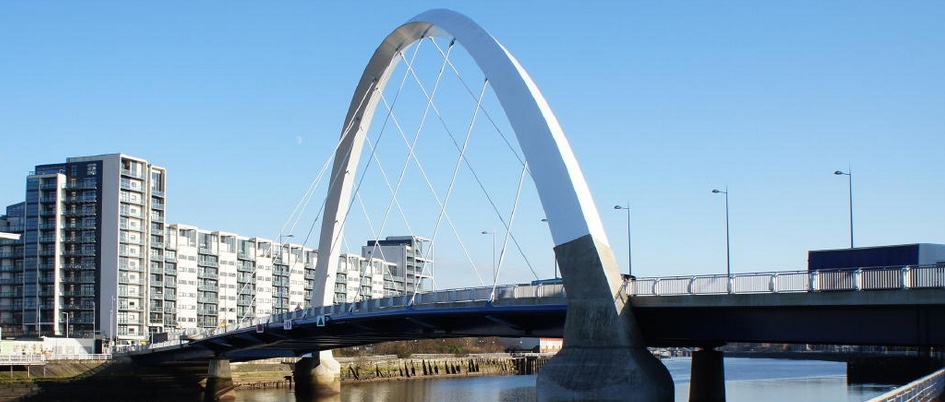

The Clyde Arc (known locally as the Squinty Bridge) is a road bridge spanning the River Clyde in Glasgow, Scotland, connecting Finnieston near the Clyde Auditorium and SEC with Pacific Quay and Glasgow Science Centre in Govan. A prominent feature of the bridge is its innovative curved design and the way that it crosses the river at an angle. The Squinty Bridge (Finnieston Bridge or The Clyde Arc) has a 140m single span across the river Clyde, joining Finnieston on the north bank with Pacific Quay on the south.
The Squinty Bridge, affectionately known to Glaswegians as such despite its official title of Clyde Arc, gracefully arches over the River Clyde in the heart of Glasgow, linking the bustling Finnieston district to the vibrant Pacific Quay area. Opened in 2006 after a £20 million investment, this striking structure was engineered to weave seamlessly into the city’s riverside regeneration, allowing ships to pass beneath while carrying vehicular traffic at a jaunty 50-degree angle to the water. Its curved steel form, rising 21 meters high, has quickly become an emblem of modern Glasgow, blending industrial grit with contemporary flair.
What truly sets the Squinty Bridge apart is its unconventional design, which prompted locals to dub it “squinty” for the way it appears to peer sideways across the river, as if casting a sly glance at the surrounding landmarks. The bridge’s innovative arch supports navigation for tall vessels, with a clearance of about 5.4 meters at mean water level, and it integrates pedestrian paths that invite walkers to pause and absorb the panoramic views of the Clyde’s shimmering expanse. From here, one can spot nearby icons like the Armadillo auditorium and the Science Centre, making it a favored spot for photographers and evening strollers alike.
Over the years, the Squinty Bridge has weathered a few challenges, including a temporary closure in 2008 due to structural concerns with its hangers, but repairs ensured its swift return to service, underscoring Glasgow’s commitment to resilient urban infrastructure. Today, it stands as a vital artery for daily commuters and tourists exploring the city’s west end, symbolizing the forward momentum of a place that honors its shipbuilding heritage while embracing bold new horizons. Crossing it feels like stepping into Glasgow’s spirited future, one tilted glance at a time.



 Own or work here?