

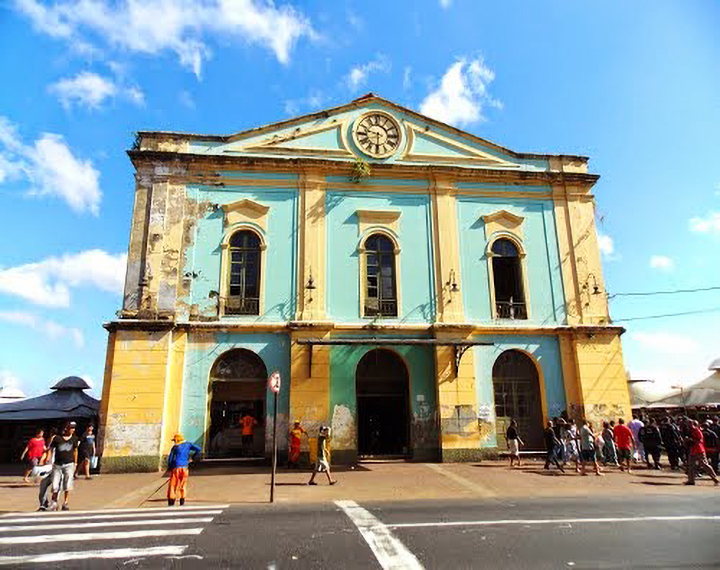
The Solar da Beira is a historic neoclassical building located in the Cidade Velha neighborhood of Belém, Pará, Brazil. Situated on the shores of Guajará Bay, it forms part of the Ver-o-Peso Complex, a significant cultural and architectural ensemble that has been recognized as a national heritage site by the Instituto do Patrimônio Histórico e Artístico Nacional (IPHAN) since 1977.
Although the exact date of its construction remains undocumented, it is believed to have been erected in the late 19th or early 20th century, possibly around the same time as the Mercado de Ferro, which opened in 1901 . In the early 20th century, the building served as the Revenue Office (Recebedoria de Rendas), playing a role in the administrative functions of the city.
Over the years, the Solar da Beira has undergone several transformations. In 1985, during the municipal administration of Almir Gabriel, the building was repurposed into a restaurant and cultural space . Later, in 1998, the façade was renovated under the administration of Edmilson Rodrigues . The most recent renovation began in 2019 and was completed in November 2020. This restoration included structural repairs, rustproofing of metal elements, hand-painting of tiles, and treatments to prevent wood decay and insect infestation. Additionally, accessibility features and air conditioning were installed to enhance visitor comfort.
Currently, the Solar da Beira houses two main exhibitions. On the ground floor, visitors can explore displays inspired by the Círio de Nazaré, a major religious festival in Belém. The upper floor features an exhibition of paintings and ceramic objects, showcasing local artistic expressions . The building also hosts a product fair, offering a variety of local crafts and goods.
During the renovation process, archaeological excavations uncovered a range of artifacts, including porcelain fragments, clay and glass bottles, cutlery, cans, coins, and even horseshoes and wheels. These findings, estimated to date from the 20th century, have been integrated into Brazil’s archaeological heritage, providing valuable insights into the region’s history. The Solar da Beira stands as a testament to Belém’s rich cultural and architectural heritage. Its neoclassical design and historical significance make it a noteworthy destination for visitors interested in exploring the city’s past and artistic traditions.



 Own or work here?