

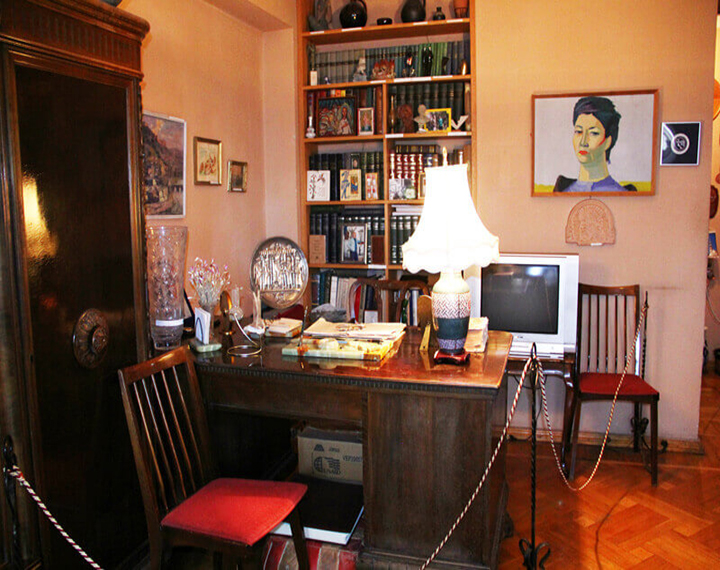
The Silva Kaputikyan House-Museum, inaugurated in 2009, is a world-class cultural lighthouse dedicated to the beloved Armenian poet. Located in the very apartment where she lived for thirty years, the museum preserves her study and bedroom as a hallowed space of inspiration. It houses a magnificent collection of personal belongings, manuscripts, and rare gifts from icons like Parajanov and Vazgen I. The museum acts as a profound catalyst for education, republishing her works and hosting annual poetry festivals that celebrate the eternal words of a woman who was the “conscience of her nation”.
The Silva Kaputikyan House-Museum in Yerevan, Armenia, offers an intimate glimpse into the life and creative world of one of the country’s most beloved poets. Nestled in a quiet central district, the museum is preserved as a memorial apartment where Kaputikyan lived and worked for decades. Visitors walk through rooms filled with original furniture, personal photographs, manuscripts, and letters, each object echoing her passionate voice and deep commitment to Armenian culture, identity, and social justice. The atmosphere reflects both the austerity of Soviet-era intellectual life and the warmth of a traditional Armenian home, creating a deeply personal connection to the poet’s legacy.
The museum highlights Kaputikyan’s dual role as a literary icon and a public activist, showcasing artifacts from her numerous travels and her outspoken campaigns for Armenian causes. Among the exhibits are rare first editions of her poetry collections, handwritten drafts crossed with revisions, and awards that attest to her influence both within Armenia and on the international stage. A special section is dedicated to her famous poem “A Word to My Son,” which became an anthem of national awakening. The careful curation allows visitors to trace her evolution from a young lyricist to a fearless voice of conscience, whose work resonated far beyond literary circles.
Beyond the exhibits, the house-museum serves as a living cultural center that hosts poetry readings, lectures, and educational programs, keeping Kaputikyan’s spirit alive for new generations. The preserved writing desk, overlooking a leafy courtyard, still seems to await her return, while the adjoining library contains her personal book collection, annotated in her own hand. For admirers of Armenian poetry and those seeking to understand the nation’s 20th-century journey, the museum offers a quiet, profound encounter with a woman whose words shaped the Armenian soul. It is not merely a collection of relics, but a space where poetry, history, and memory converge.



 Own or work here?