

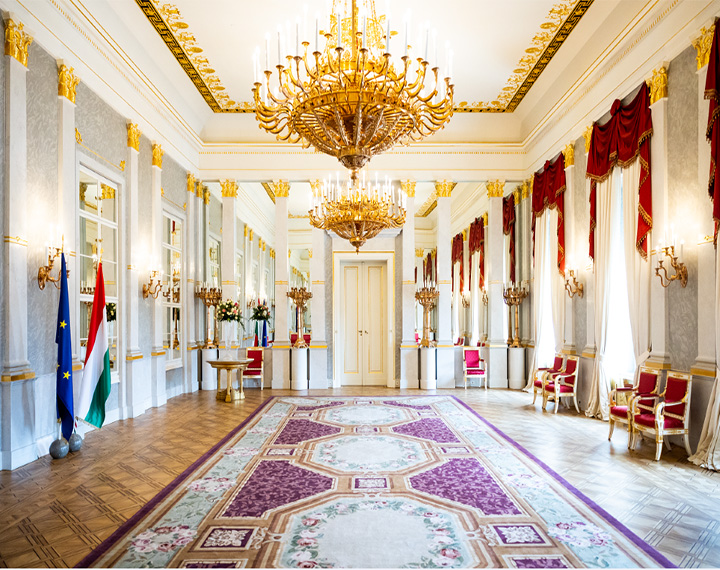
Experience the neoclassical elegance of the official residence of the President of Hungary. The Sándor Palace stands as a dignified architectural gem atop the scenic Castle Hill, serving as the official residence and offices of the President of the Republic. This historic building radiates an atmosphere of understated power and classical beauty, characterized by its clean lines and symmetrical facade. It is an inviting landmark for those exploring the Buda Castle District, offering a glimpse into the formal diplomatic life of the nation within a setting that has witnessed centuries of political transformation.
* The palace features a stunning neoclassical exterior with intricate friezes depicting mythological scenes and historical allegories.
* It is famous for the ceremonial Changing of the Guard, which takes place at the top of every hour and is a favorite spectacle for visitors.
* The interior, though generally closed to the public except on special open days, houses magnificent reception rooms decorated with period furniture and silk tapestries.
* Located in Szent György Square, it offers some of the most spectacular views of the Danube, the Chain Bridge, and the Pest skyline.
Culturally, the palace is a symbol of Hungarian statehood and the restoration of national traditions following the democratic transition. It acts as a primary stage for high-level diplomatic meetings, the credentialing of ambassadors, and the hosting of foreign heads of state. The building’s presence in the heart of the UNESCO World Heritage site of the Castle District reinforces the connection between Hungary’s medieval royal roots and its contemporary democratic institutions, making it a vital piece of the city’s cultural tapestry.
Historically, the palace was commissioned by Count Vincent Sándor and completed in 1806, designed by the architects Johann Aman and Mihály Pollack. Throughout the 19th and early 20th centuries, it served as the residence of the Prime Minister of Hungary, including notable figures like Count Gyula Andrássy. After suffering significant damage during World War II, the palace underwent a meticulous and faithful restoration at the turn of the millennium, reopening in 2003 to reclaim its status as one of the most important historical seats of government in Central Europe.
Tourists find the palace to be an essential and uplifting stop during a walking tour of Buda, providing a perfect sense of the city’s regal history. Its proximity to the Matthias Church and the Fisherman’s Bastion makes it a convenient highlight of any historical itinerary. The square in front of the palace is a spacious, pedestrian-friendly area that allows for peaceful contemplation of the architecture and the dramatic history it represents, leaving every visitor with a profound sense of the resilience and elegance of the Hungarian capital.



 Own or work here?