

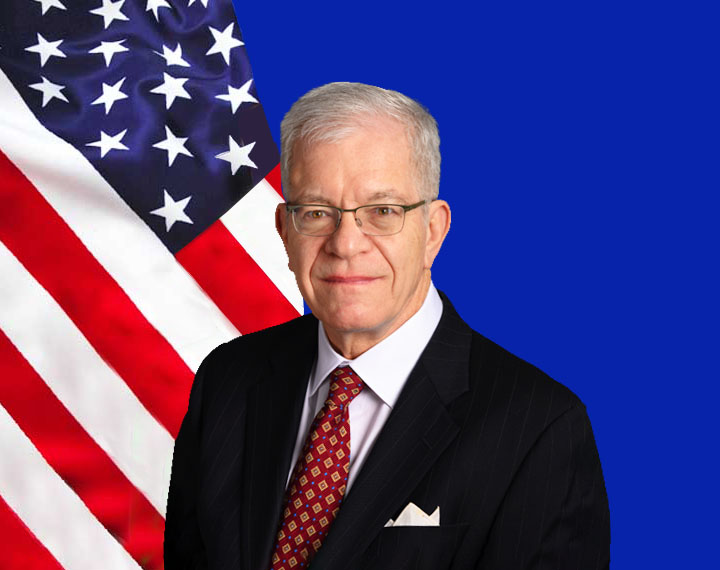
His Excellency Robert Silverman joined the U.S. diplomatic service in order to learn about the Middle East, a region of the world that fascinated him growing up in Iowa, and to work on behalf of the American people.
He had earlier studied Arabic at Princeton University and in a post-graduate year at the American University in Cairo. In the diplomatic service, Robert, later joined by his wife Young-Mi, worked in embassies throughout the Middle East, including in Cairo, where their daughter was born and grew up. During those years in Cairo, Robert became friends with the late Egyptian playwright Ali Salem and, with Ali’s permission, translated one of his books into English, published as A Drive to Israel in 2002.
For the past ten years, Robert has worked in the private sector, co-founding a Muslim-Jewish organization in the United States called IJMA (“Inter Jewish Muslim Alliance”), teaching college courses on American foreign policy, and serving as editor-in-chief of a foreign affairs journal, The Jerusalem Strategic Tribune.
Robert was recalled to the U.S. diplomatic service in February 2026 in order to assume responsibility for leading the U.S. embassy in Cairo at a critical time for Egypt and the United States.
Chargé d’Affaires Robert Silverman a purpose-driven diplomat fostering trust, dialogue, and enduring partnerships across cultures stands as a compelling example of modern diplomacy shaped by dedication, cultural fluency, and a belief in the quiet power of relationships. Serving as Chargé d’Affaires at the Embassy of the United States of America in Cairo, he carries the responsibility of representing American values while nurturing one of the most strategically significant partnerships in the world. His leadership reflects a steady commitment to dialogue, cooperation, and mutual respect.
Across his diplomatic career, His Excellency Robert Silverman has embraced complex international environments with calm precision and intellectual curiosity. His work has spanned regions and disciplines, allowing him to develop a nuanced understanding of global affairs and the human stories that shape them. In Cairo, a city where ancient heritage meets modern ambition, he engages with leaders, innovators, and communities, strengthening ties that extend far beyond policy into shared aspirations. Colleagues often recognise his ability to listen deeply and act thoughtfully, qualities that define effective diplomacy in an ever-evolving world.
Whether navigating sensitive political conversations or championing educational, cultural, and economic exchanges, Silverman embodies a style of leadership grounded in respect and collaboration. His work highlights how diplomacy is not only about negotiation, but about building bridges of understanding that endure.
At the heart of his journey lies a belief that international partnerships can unlock opportunity, stability, and progress. Through his role, he supports initiatives that empower young people, encourage innovation, and deepen cultural appreciation between nations. His presence in Egypt underscores a broader mission: to cultivate trust, inspire cooperation, and open doors for future generations. Robert story is one of excellence, purposeful service, where professionalism meets empathy and global vision meets local connection. In representing the United States abroad, he demonstrates that diplomacy, at its best, is a human endeavour—one that inspires progress through patience, integrity, and the courage to connect.
The United States Embassy in Cairo stands as one of the most significant diplomatic missions in the entire Middle East and North Africa region — a testament to the enduring and consequential relationship between two nations whose partnership has helped shape the modern world. Established formally following the recognition of Egyptian sovereignty, the Embassy has grown over the decades into a vast and multifaceted institution, serving not only the practical needs of American citizens and Egyptian visa applicants, but fulfilling a far deeper purpose: the nurturing of mutual understanding, shared security interests, and the promotion of democratic values across a region of extraordinary strategic importance. Its presence in Cairo — the Arab world’s most populous capital — reflects the depth of commitment the United States holds toward Egypt and the broader stability of the region.
The Embassy’s work extends far beyond the processing of consular services, important as those functions are. Through a wide range of programmes spanning education, cultural exchange, economic development, and civil society support, the mission actively invests in the human potential of Egypt’s people. The Fulbright Programme, administered in part through the Embassy, has sent generations of Egyptian scholars to American universities and welcomed American academics to Egyptian institutions, building intellectual bridges that outlast any single administration or policy era. The American Corners network, supported by the Embassy across multiple Egyptian cities, provides communities with access to English language resources, digital libraries, and civic education — quiet but powerful instruments of connection between two cultures separated by an ocean yet bound by shared aspiration.
At its finest, the United States Embassy in Cairo represents something greater than the sum of its administrative functions. It is a living symbol of the proposition that nations with different histories, different faiths, and different political traditions can nonetheless find common ground through dialogue, respect, and a sincere commitment to one another’s wellbeing. The relationship between the United States and Egypt — forged through decades of cooperation on regional security, cemented by landmark agreements, and sustained through periods of both challenge and renewal — remains one of the most consequential bilateral partnerships in the world. The Embassy, standing in one of history’s greatest cities, is the daily, human expression of that enduring bond.



 Own or work here?