

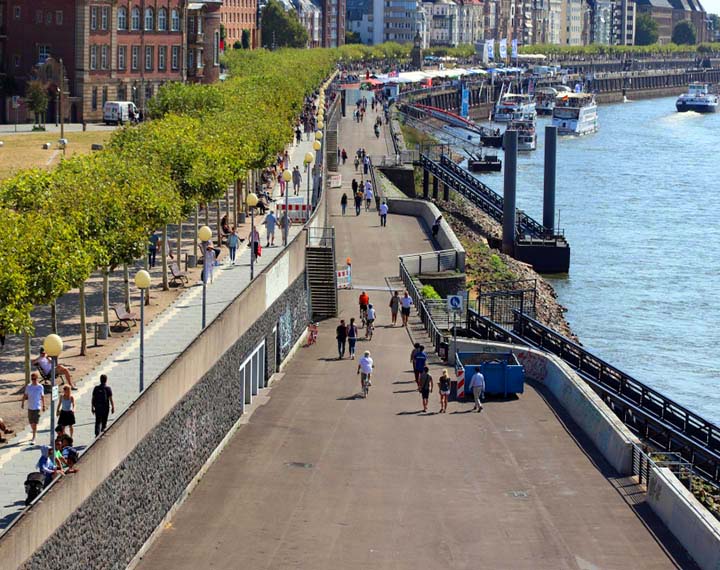
 Rheinuferpromenade Düsseldorf
The Rheinuferpromenade refers to the landscaped banks of the Rhine at the height of the Düsseldorf districts Altstadt , Carlstadt and Hafen . Other cities also have Rhine promenades; here it includes the streets Tonhallenufer , Schlossufer , Rathausufer and Mannesmannufer .
The promenade was created in the course of the Rhine bank advance in the years 1898 to 1902. At that time, two levels were built. The lower one served to handle shipping traffic and provided space for the necessary facilities. At that time there was already a promenade on the upper level.
After the Second World War, the banks of the Rhine were redesigned for the federal highway 1 . A multi-lane road was built next to, and sometimes instead of, the promenade, which separated the city center from the Rhine due to its barrier effect.
After the construction of the Rhine bank tunnel in the 1990s, during which the entire federal highway was laid underground, the Rhine bank was redesigned according to the plans of the architects Niklaus Fritschi , Benedikt Stahl and Günter Baum. In 1995, two years after the completion of the tunnel, the new promenade was celebrated with a big party by a million visitors. Since then it has been a popular destination for Düsseldorf residents and tourists. The outside staircase at Burgplatz is often occupied by visitors to the old town. Since 2007, the KIT Museum has been located at the level of the former Mannesmann high-rise building. Further south, below the Rheinkniebrücke, the new Apollo Varieté was built. The expansion as a promenade ends in the southern part at the state parliament building of North Rhine-Westphalia.
The design of the Rhine promenade has received several awards, e.g. 1998 with the German Urban Development Prize .



 Own or work here?