

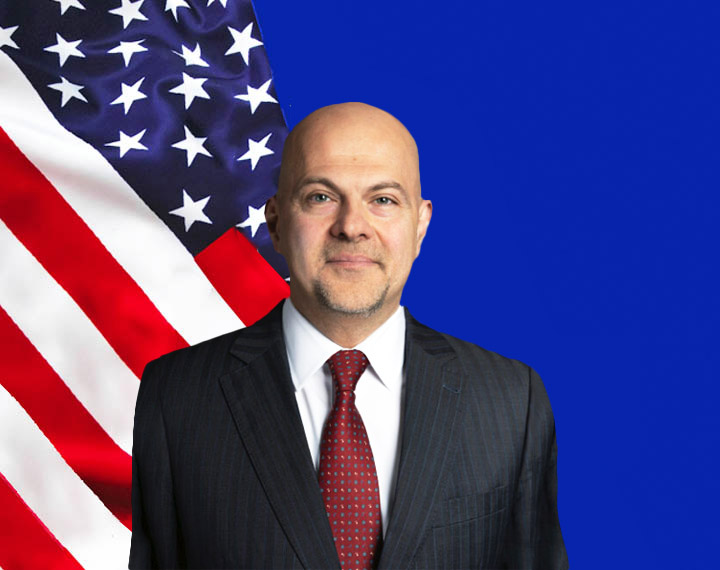
Rafik Mansour has served as the United States Principal Officer and Consul General in Jeddah since April 2025. He is also accredited to the Organization of Islamic Cooperation as the U.S. Representative.
A career member of the Senior Foreign Service with the rank of Minister-Counselor, Mr. Mansour previously served as the Deputy Assistant Secretary for Policy at the Department of State’s Bureau of Educational and Cultural Affairs (2022-2025). His most recent assignments abroad include Chargé d’Affaires, a.i. (Acting Ambassador) in Singapore (2019-2021) and Deputy Chief of Mission in Armenia (2016-2019). His diplomatic career has spanned 26 years and includes prior postings in Russia, France, Italy, Iraq, Libya, Algeria, and Haiti.
Mr. Mansour is the recipient of three Senior Foreign Service Performance Awards as well as numerous State Department Superior and Meritorious Honor Awards. He earned a Master’s degree in National Security Strategy from the National War College in addition to a B.S. in Biology and a B.A. in French Literature from the University of California, Irvine. He speaks Arabic, French, Italian, Russian, and Creole.
Rafik is an inspiring example of how determination, intellect, and cultural empathy can create meaningful change on a global stage. Born into a family that valued education and service, Rafik cultivated a passion for bridging cultures and fostering understanding from an early age. This passion led him to pursue higher education in international relations, setting the foundation for a stellar career in diplomacy.
Over decades of service as a Senior Foreign Service Officer, Rafik Mansour has exemplified dedication, resilience, and vision. His tenure spans continents, from representing the United States in some of the world’s most complex geopolitical environments to forging people-to-people connections through innovative cultural programs. Whether serving as Deputy Assistant Secretary in the Bureau of Educational and Cultural Affairs or as the U.S. Consul General in Jeddah, Rafik has consistently focused on building trust, fostering partnerships, and promoting mutual respect.
Throughout his career, Rafik has championed dialogue and collaboration, recognizing the transformative power of shared understanding. His leadership is defined not only by his ability to navigate complex global challenges but also by his commitment to mentoring the next generation of diplomats. Rafik’s journey is a testament to the idea that one person, driven by a desire to unite and inspire, can leave an indelible mark on the world stage.
A dynamic leader and a steadfast advocate for peace, Rafik Mansour reminds us that diplomacy is not just about politics—it’s about people. His legacy continues to inspire others to embrace diversity, nurture dialogue, and work tirelessly to create a better, more connected world.
The American Mission to Saudi Arabia began as a legation in Jeddah in 1942. Full diplomatic relations commenced in 1949 and the U.S Mission, located in a traditional house in the old city center, became an Embassy. The Embassy moved in 1952 to the Al Hamra district Consulate General location, which at the time was an isolated, beach-front property far to the north of the city limits. Along with all other foreign missions, the Embassy was transferred to Riyadh in 1984. The former Embassy compound in Jeddah housed the Consulate General until 2019, when the Consulate was relocated to its present site in Al Muhammadiyah.
Known locally as “The Bride of the Red Sea,” Jeddah lies at about the same latitude as Honolulu and Hong Kong, and it shares their hot, humid climate. Tradition has it that the city derives its name (meaning grandmother, in Arabic) from the legend that the biblical Eve was buried here. Since nearly the inception of Islam, it has been the main point of entry for foreign pilgrims intending to perform the Hajj or pilgrimage to Makkah. Ottoman caliphs personally selected it as the ideal locale over rivals to the north and south. Jeddah’s advantage was that it already was an established port with a history of facilitating the pre-Islamic pilgrimage and spice trades in the Hejaz, the western region of what is now Saudi Arabia.



 Own or work here?