

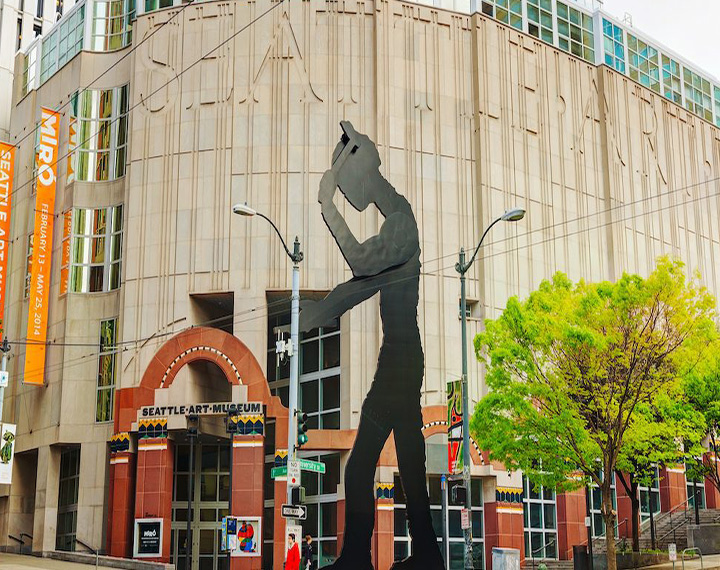
Motorized, silhouette-style sculpture, constructed in 1991, of a 21-m. hammering man. The Hammering Man by Jonathan Borofsky has been considered a landmark of Frankfurt since its installation in 1991. It depicts a human figure tirelessly striking a hammer against a workpiece, powered by a motor. The artist describes the sculpture as a “symbol for the worker in all of us.” The movement of the hammer, “from the mind to the hand and back again,” symbolizes the connection between intellect and action, thoughts and deeds. Borofsky emphasizes, “We all use our minds and our hands to create our world. I like to say that between the mind and the hand, there is the heart.”
From the outset, Borofsky planned multiple versions of the sculpture to be installed in different locations and contexts. Examples include installations in San Diego (since 1988, in front of the Museum of Contemporary Art), Basel (since 1989, in front of the UBS headquarters), and Seoul (since 2002; with a height of 22 meters, it is the largest figure). The Frankfurt sculpture stands in front of the Messeturm and, at 21 meters tall, ranks among the tallest specimens of the series. Thus, simultaneous hammering across the globe: “sort of a worldwide installation connecting us all together” – a symbol for working people worldwide.
Another connection spanning continents and time is offered by the commissioner of Borofsky’s sculpture. Jerry Speyer is not only a co-founder of the New York real estate company that built the Messeturm. He is also a descendant of the enormously successful banking family Speyer, whose roots date back to 17th-century Frankfurt.



 Own or work here?