

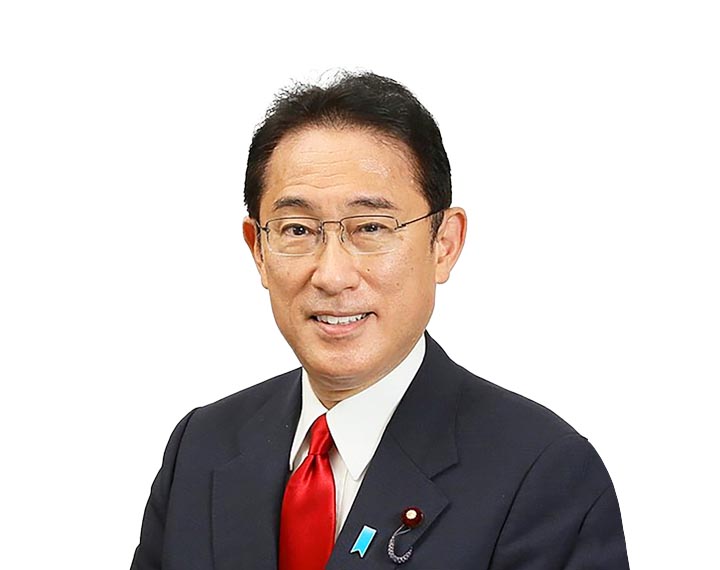
Fumio Kishida is a Japanese politician serving as Prime Minister of Japan and president of the Liberal Democratic Party since 2021. A member of the House of Representatives, he previously served as Minister for Foreign Affairs from 2012 to 2017 and as acting Minister of Defense in 2017.
Fumio Kishida born on July 29, 1957, in Hiroshima, Japan, is the current Prime Minister of Japan, having taken office on October 4, 2021. Growing up in a politically influential family, Kishida was deeply influenced by the legacy of his father, who was a member of the House of Representatives. He pursued his education at Waseda University, studying law before embarking on a career in politics. His early experiences in the Ministry of Foreign Affairs provided him with a solid foundation in diplomacy and international relations.
Kishida’s political career began when he was elected to the House of Representatives in 1996. He held several significant roles, including Minister for Foreign Affairs from 2012 to 2017, where he played a key role in shaping Japan’s foreign policy and strengthening international relations. His tenure also included positions as Minister for Administrative Reform and Chair of the LDP’s Policy Research Council. These roles helped him build a reputation for effective policy-making and strategic thinking within the Liberal Democratic Party (LDP).
As Prime Minister, Kishida has focused on navigating the challenges of the COVID-19 pandemic, revitalizing Japan’s economy through his “new capitalism” approach, and enhancing the country’s security and international standing. His leadership is characterized by a pragmatic approach to governance and a commitment to strengthening Japan’s global alliances. Kishida’s personal background, combined with his extensive political experience, has shaped his administration’s priorities and responses to both domestic and international issues.
Japan operates as a constitutional monarchy with a parliamentary system, combining traditional elements with modern democratic practices. The Emperor serves as the ceremonial head of state, with the current Emperor Naruhito having ascended the throne on May 1, 2019. His role is symbolic and includes performing state ceremonies and representing Japan in diplomatic functions, but he does not hold governing power.
The executive branch is led by the Prime Minister, who is the head of government and holds significant political authority. The Prime Minister is appointed by the Emperor based on the support of the majority in the House of Representatives, Japan’s lower house of parliament. The Prime Minister oversees the Cabinet, which is responsible for administering government departments and implementing policies. As of July 2024, Fumio Kishida serves as Prime Minister, having been in office since October 2021.
Japan’s legislative branch, known as the National Diet, consists of two houses: the House of Representatives and the House of Councillors. The House of Representatives, with members elected for four-year terms, holds substantial legislative power, including the authority to initiate and approve laws and select the Prime Minister. The House of Councillors, elected for six-year terms, acts as a revising chamber and provides oversight. The judiciary is independent, with the Supreme Court serving as the highest court, ensuring laws and executive actions adhere to the constitution.



 Own or work here?