

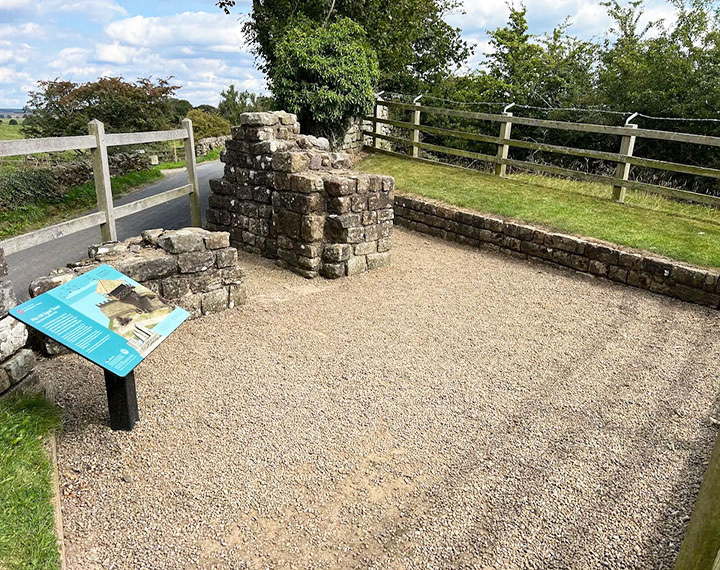
Pike Hill is one of the few visible elements of the Roman frontier that pre-date Hadrian’s Wall. Before the Wall was built in the early 2nd century AD, the soldiers posted here communicated by signalling to the forts along Stanegate, the road that ran east to west, south of what became the Wall. Later incorporated into Hadrian’s Wall, the tower commands magnificent views, which show exactly why this isolated site in Cumbria was chosen as a watch point.
The Roman army advanced through northern England and into Scotland in the AD 80s while attempting to conquer Britain. Uprisings elsewhere in the empire meant that the army then retreated to a frontier across the narrowest part of northern England – the Tyne–Solway isthmus.
Under the emperor Trajan (r.AD 98–117), the frontier consisted of a system of fortifications on or near a road now known as the Stanegate, which ran east–west between Corbridge and Carlisle. Several large forts, such as Vindolanda, and smaller fortlets were built along the road. These were bases for Roman military operations along the northern border of the province of Britannia, and homes to the soldiers who protected Britannia from hostile tribes in the north.
Pike Hill was one of various signal towers that stood on high ground usually to the north of the Stanegate. It offered commanding views in all directions, allowing the small garrison to monitor the landscape. They could signal to the nearest forts at Nether Denton (1¼ miles away) and Castle Hill, Boothby (2½ miles away), where larger forces of up to 1,000 soldiers could respond to any threats. Then in the AD 120s the situation changed when the new emperor, Hadrian (r.117–38), completely reshaped the borders of the Roman Empire.



 Own or work here?