

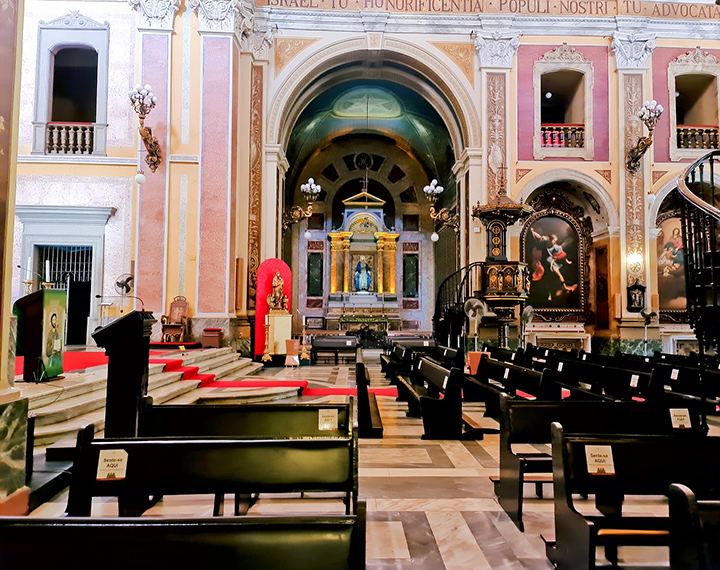
Its twin bell towers, visible from the Guajará Bay, became navigational markers for arriving vessels, blending practical function with spiritual symbolism. Inside, the high vaulted ceilings, altars adorned with gold leaf, and sacred art created a setting meant to lift the soul heavenward, reaffirming the Church’s authority while offering comfort to a diverse population of settlers, Indigenous peoples, and enslaved Africans. The cathedral’s architecture carries echoes of Lisbon, yet it is adapted to the tropical environment, a fusion that mirrors Belém’s unique cultural identity. Symbolically, the cathedral represents resilience and continuity.
For centuries it has hosted the Círio de Nazaré, one of the world’s largest Catholic processions, where millions gather to honor the Virgin Mary. In this role, it is not only a house of worship but also a unifying stage for faith, tradition, and belonging. Its bells have tolled for moments of conquest, resistance, celebration, and mourning, making it a living chronicle of Belém’s story. Today, the Cathedral of Our Lady of Grace is not just a monument to faith, but a testament to the intertwining of history, spirituality, and cultural identity in the Amazon’s gateway city.



 Own or work here?