


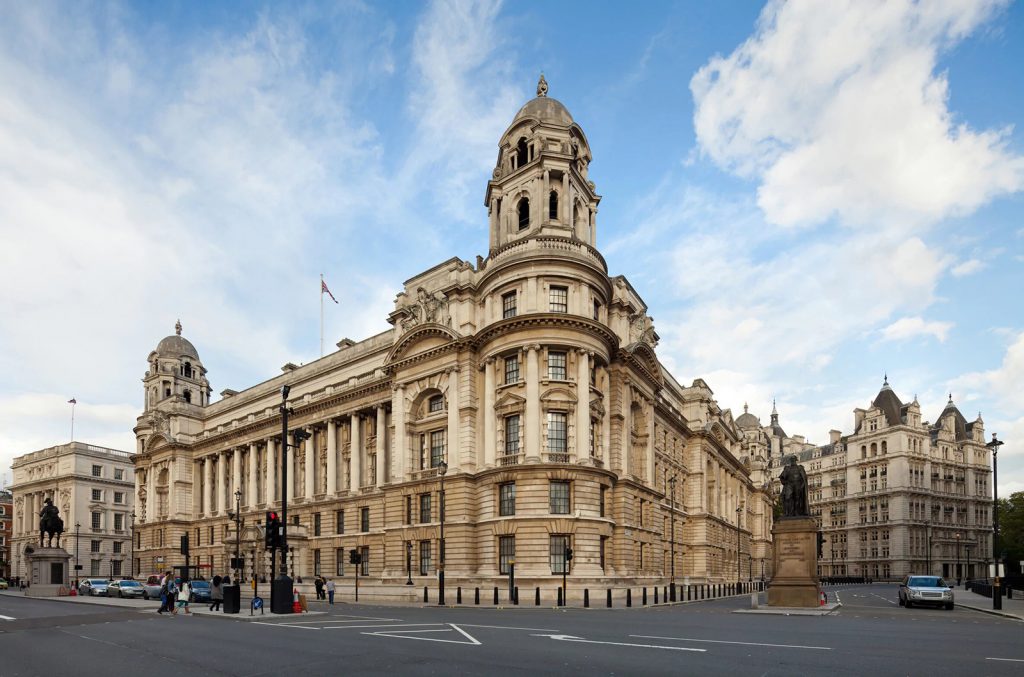
Old War Office Building
Designed by British architect William Young, the War Office was built on the site of the Palace of Whitehall – home for centuries to English monarchs, including King Henry VIII. Built in the Baroque style, the landmark building was completed in 1906 and stood as silent witness to world-shaping events of the twentieth century. Influential political and military leaders, including Winston Churchill, Lord Haldane and T. E. Lawrence walked these corridors of power, while the Grade II* listed building inspired Ian Fleming’s James Bond series, and has featured in numerous Bond films. Today, the legacies of the Old War Office’s iconic cast of characters continue in the names of the suites and rooms of The OWO. The story continues.
The War Office was a Department of the British Government responsible for the administration of the British Army between 1857 and 1964, when its functions were transferred to the Ministry of Defence. It was equivalent to the Admiralty, responsible for the Royal Navy, and the Air Ministry, which oversaw the Royal Air Force. Former office building with 1,100 rooms used by Churchill as a headquarters during World War II. The Old War Office Building is a Grade II* listed building in Whitehall, London SW1. The building will be converted into a luxury Raffles Hotel and private residences to the designs of EPR Architects. The transformed building will comprise 125 guest rooms and 85 apartments. The OWO Residences by Raffles
The Old War Office Building, a striking landmark on Whitehall in London, stands as a powerful symbol of Britain’s military administration and strategic history. Constructed between 1898 and 1906, its grand Edwardian Baroque architecture, with red brick and Portland stone accents, was designed to convey authority, order, and the strength of the British state. For over a century, it housed the administrative heart of the British Army, coordinating military planning, logistics, and operations from its central location at the heart of the nation’s government.
The significance of the building lies in its role as the headquarters of the War Office, where decisions shaping Britain’s military engagements, both at home and abroad, were made. From the World Wars to post-war military planning, the Old War Office was central to the coordination of defence strategy and the administration of the armed forces. Many notable military and political figures worked within its walls, and it was a place where key moments of British history, from strategic wartime deliberations to administrative reforms, were orchestrated.
Symbolically, the Old War Office represents Britain’s military tradition, national service, and the seriousness of statecraft in times of conflict. Today, while it no longer serves as the War Office, the building has been repurposed for commercial and residential use, but its historic gravitas remains visible in its architecture and its presence in Whitehall. Its iconic façade and historical significance continue to remind visitors of Britain’s long-standing dedication to defence and governance, bridging the past with the modern city that surrounds it.
Rate us and Write a Review
 Open Now~09:00 - 18:00
- Saturday09:00 - 18:00
- Monday09:00 - 18:00
- Tuesday09:00 - 18:00
- Wednesday09:00 - 18:00
- Thursday09:00 - 18:00
- Friday09:00 - 18:00


 Own or work here?
