

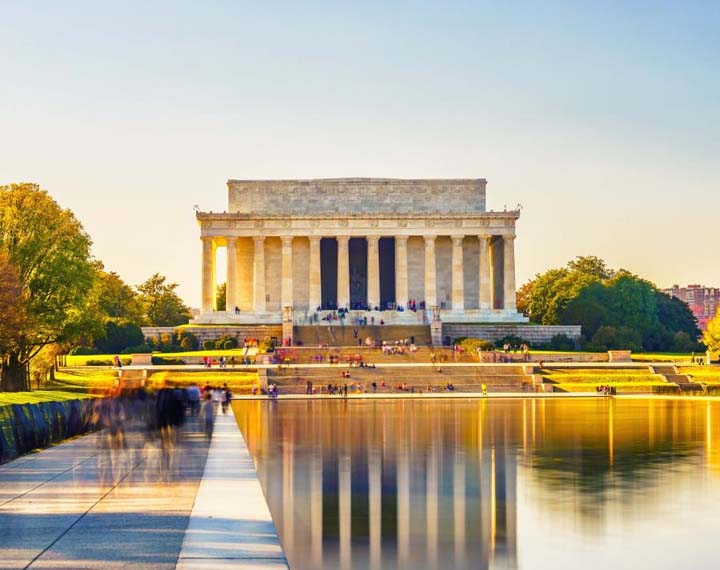
The National Mall in Washington, D.C., is not only a prominent civic space but also a testament to America’s history and ideals. Envisioned as a grand, open space at the heart of the nation’s capital, its concept dates back to Pierre Charles L’Enfant’s original 1791 plan for Washington, D.C. L’Enfant imagined a wide avenue stretching west from the Capitol, lined with gardens, monuments, and civic buildings that would embody the principles of democracy and unity.
Throughout its history, the National Mall has undergone significant transformations to become the space we recognize today. The early 19th century saw modest development, but it wasn’t until the McMillan Plan of 1901, inspired by the City Beautiful Movement, that the Mall was reimagined. This plan introduced the familiar open lawns, symmetrical pathways, and iconic sightlines, creating a harmonious design that emphasized the Mall as a space for reflection, commemoration, and public assembly.
Over time, the National Mall has evolved into a living symbol of American ideals. It hosts memorials honoring presidents, soldiers, and civil rights leaders, including the Lincoln Memorial, the Jefferson Memorial, and the Martin Luther King Jr. Memorial. These structures serve as reminders of the country’s struggles and triumphs, celebrating resilience, freedom, and justice.
The Mall’s role in American society goes beyond its monuments. It has been the backdrop for significant historical events, including Dr. Martin Luther King Jr.’s “I Have a Dream” speech during the 1963 March on Washington and numerous other demonstrations advocating for equality, peace, and progress. Its vast open spaces also serve as gathering points for celebrations like Independence Day fireworks, concerts, and festivals, fostering a sense of national community.
The National Mall, managed by the National Park Service, continues to be a space of inspiration and reflection. It represents the aspirations of a nation committed to learning from its past and striving for a brighter future, making it a cornerstone of American culture and history.



 Own or work here?