

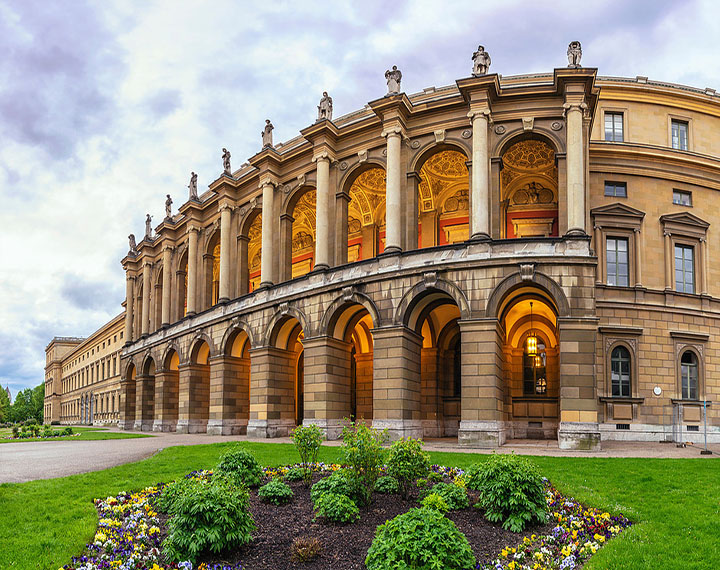
The Munich Residence served as the residential and governmental seat of the Bavarian dukes, electors, and kings from 1508 to 1918. What once began as a castle nestled in the northeastern corner of the city’s fortifications (“Neuveste,” 1385) underwent a magnificent transformation by the princes over the centuries, evolving into a resplendent seat of power, with courts and gardens extending into the city.
Chambers and art collections spanning the epochs of the Renaissance, Early Baroque, and Rococo to Classicism bear witness to the artistic sensibility and political aspirations of the House of Wittelsbach.
Following severe destruction during the Second World War, the Residence was painstakingly reconstructed starting from 1945. Today, it stands as one of Bavaria’s largest museum complexes, housing the museums of the Bavarian Palace Administration (Residence Museum, Treasury, Cuvilliés Theatre), alongside various other cultural institutions.
Palace, buildings & gardens housing state-owned museums, with original interiors & artworks. Since 1920, the Munich Residenz has been open to the public as a museum and is today one of the most important museum museums in Europe. To this day, the extensive construction the petrified witness the self-understanding of its clients represent the rulers of the House of Wittelsbach, the first as dukes, since the 17th century ruled as electors and from 1806 to 1918 as kings in Bavaria.
The centuries maintained function of the residence as a main living and seat of government of the ruler can be today seen in architecture and interior design: From 16th to 19th century here space art of Renaissance, Baroque and Rococo, Classicism and Historicism emerged on each highest Artistic as well as material level. In these, the visitors to this day are able to understand and experience the forms of princely self-expression that have come to an end in the epochs of humanism, counter-reformation and enlightenment, divine mercy and constitutional monarchy.
This is possible because in the Munich residence, the precious furnishings of the rooms – furniture and paintings, carpet paintings, sculptures, treasures and religious devotional objects – are still predominantly in the places for which they were once created. The unity of artistic and historical significance of space and equipment is therefore rarely seen here.



 Own or work here?