

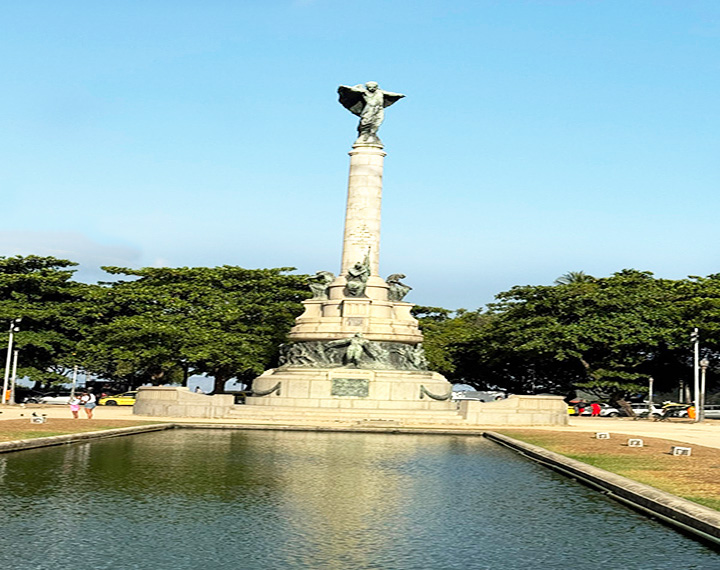
The monument is a striking and beautiful structure made of white marble that stands out in the square. It was erected to honor the memory of the military personnel who resisted and were killed during the rebellion known as the “Communist Uprising” of November 1935. The location was not chosen by chance. The Urca neighborhood was the epicenter of the clashes in Rio de Janeiro, as one of the main attacks of the revolt took place at the barracks of the 3rd Infantry Regiment, where the Army’s Physical Fitness Training Center is located today. The soldiers who resisted the insurrection are the heroes celebrated by this landmark.
The monument serves as a physical reminder of a crucial moment in Brazilian history, symbolizing the resistance and sacrifice of those who defended the constitutional order at the time. It is an important historical piece that complements the natural beauty of Praça General Tibúrcio. The uprising, led by Luís Carlos Prestes and the National Liberation Alliance (ANL), was a failed military revolt against Getúlio Vargas’s government, occurring in Natal, Recife, and Rio de Janeiro between November 23 and 27, 1935. Its historical significance lies in its role as a pretext for Vargas to consolidate power, leading to widespread repression.
The 1935 uprising involved low-ranking military personnel and leftist supporters who sought to overthrow Vargas’s regime, driven by the ANL’s platform of land reform, democracy, and resistance to foreign exploitation. In Rio, a notable episode was the attempt to seize the Aviation Regiment at Campo dos Afonsos to bomb the city, which was thwarted by loyalist forces. No dedicated monument commemorates these events in Rio, though the city hosts other historical monuments, such as the Monument to the Dead of World War II in Flamengo Park.
The lack of a monument may reflect the uprising’s controversial legacy, as Vargas’s government demonized participants, accusing them of betraying national values, leading to mass arrests and persecution. The absence of such a structure suggests a deliberate choice to prioritize other historical narratives in Rio’s public spaces. Instead, the event is remembered through historical records and discussions of its political impact, particularly Vargas’s subsequent authoritarian measures.



 Own or work here?