

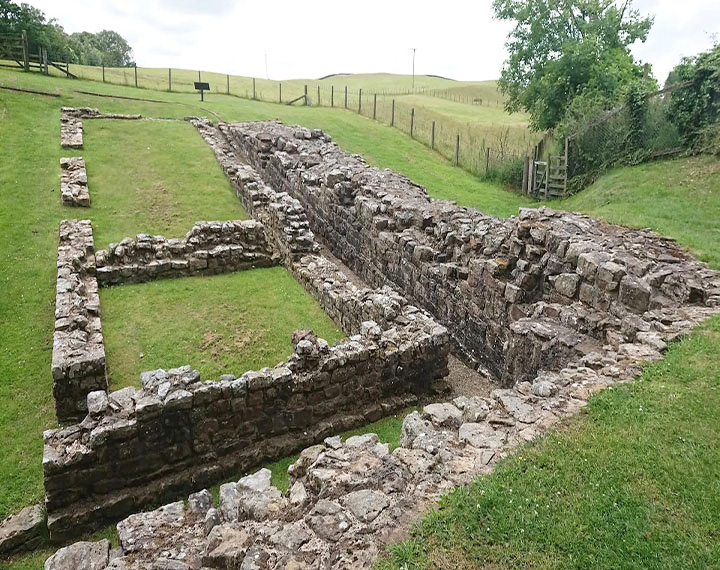
One of the best-preserved milecastles on Hadrian’s Wall, Poltross Burn Milecastle is unusually large: it contained two barrack blocks, one on either side of a central road. Known locally as the King’s Stables, it also includes an oven, a stair to the ramparts walk, and the remains of its north gateway.Milecastles were part of the original design for Hadrian’s Wall before a major change of plan – to incorporate large forts on the Wall – was made part way through its construction. Each milecastle covered a gateway through the Wall and would have allowed soldiers to patrol to the north. Civilians may also have moved in and out of the Roman province via these gates. Each milecastle probably had a garrison of between 10 and 30 soldiers.
Milecastles have a recognisable overall design. They are small rectangular walled enclosures, between 15 and 18 metres along one internal side and 17–23 metres on the other. Some have their longer axis parallel to the Wall (the short axis type) and others have it perpendicular to the Wall (the long axis type). They vary in detail, particularly in the design of their gates and the number and type of internal buildings. There were gates in the north and south walls: the northern ones were probably surmounted by towers. There may have been buildings just outside the walls of milecastles too, although this has not been widely studied.
The term ‘milecastle’ was first applied to these small forts in the early 18th century. From the late 19th century, they have been numbered from 1 to 80, beginning at Wallsend at the eastern end of Hadrian’s Wall. Many have been excavated but only six have substantial remains visible. English Heritage is responsible for four of these: Sewingshields (35), Cawfields (42), Poltross Burn (48) and Harrows Scar (49), plus one other at Grindon (34), where there are no remains above ground. The outlines of several more can be seen as earthworks along the Wall.



 Own or work here?