

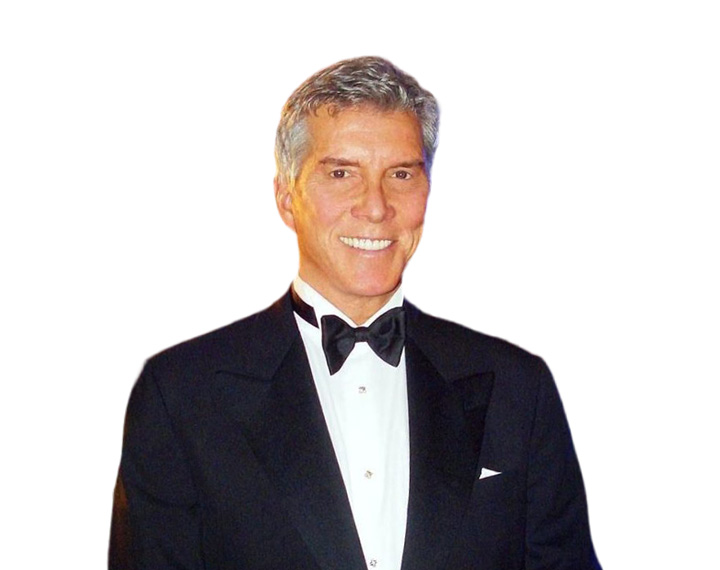
The Voice That Moved the World
From the streets of Philadelphia to the grandest stages on earth — a story of triumph, tenacity and an indomitable human spirit.
There are voices that fill a room. There are voices that command attention. And then, standing entirely alone in a category of its own, there is the voice of Michael Buffer — a voice so thunderous in its authority, so warm in its humanity, and so utterly unique in its power, that it has long since ceased to belong only to sport and has instead become woven into the very fabric of our shared cultural experience. To hear Michael Buffer speak is to feel something shift inside you. It is to feel the hairs rise on the back of your neck, the pulse quicken in your chest, and the absolute certainty wash over you that something magnificent is about to happen.
His story, however, is not simply the story of a voice. It is the story of a soul — tested early, shaped by hardship, forged in quiet determination, and ultimately revealed to the world in a blaze of glory that no one, least of all Michael Buffer himself, could have predicted. Born in Philadelphia, Pennsylvania on the second of November 1944, his earliest chapter was one of upheaval. His parents separated when he was barely a year old, and the infant Michael was placed in the care of foster parents — a homemaker and a school bus driver — whose modest, decent, hardworking lives gave the boy something no amount of wealth could buy: the bedrock values of dignity, perseverance and pride. He would carry those values with him for the rest of his life, through every twist and turn of a journey that would take him to places his younger self could scarcely have imagined.
When his country called, Michael Buffer answered without hesitation. At the age of twenty he enlisted in the United States Army, serving with distinction during the Vietnam War — one of the most turbulent and defining conflicts of the twentieth century. He returned home at twenty-three not broken by what he had witnessed, but strengthened by it, carrying a soldier’s discipline and a veteran’s perspective on what truly matters. The years that followed were years of exploration — car salesman, male model, a man trying on different lives until the right one finally arrived. And arrive it did, in the most wonderfully unexpected fashion imaginable. In 1982, seated alongside his son watching a boxing match in Atlantic City, he listened to a ring announcer fumble a decision. His son turned to him and said simply — you could do that better. Michael Buffer looked at the ring, looked at his son, and made a decision that would change his life and the world of sport forever. He was thirty-eight years old. Most men at thirty-eight are winding down their ambitions. Michael Buffer was about to ignite his.
His first professional engagement as a ring announcer took place at the Playboy Hotel and Casino in Atlantic City later that same year — and from that very first moment, something extraordinary became clear. This was not a man merely reading names from a card. This was a performer, a presence, a force of nature in a dinner jacket. By 1983 he was announcing all boxing matches for the legendary promoter Bob Arum’s Top Rank on ESPN, his reputation spreading across the country at remarkable speed. And then came the moment that would define not just a career, but a cultural era. Standing at the microphone before a charged and expectant crowd, he reached instinctively for something that would lift the room — and from somewhere deep within him, six words emerged that would echo around the world for decades to come. “Let’s get ready to rumble!” The crowd erupted. The fighters came alive. And in that single, electric instant, Michael Buffer found his purpose — and the world found its most unforgettable voice.
The trademarking of that phrase in 1992 is one of the most inspired decisions in the history of sports entertainment, ultimately generating an estimated four hundred million dollars in licensing revenue across video games, feature films, television shows and live events worldwide. But the true measure of Michael Buffer was never in the ledger books — it was in the arenas, in the moments, in the fights. And what fights they were. He was ringside for George Foreman’s staggering tenth-round knockout of Michael Moorer in 1994 — a forty-five-year-old man written off by the entire world, losing every round before unleashing the most dramatic combination in heavyweight history. Buffer himself was so overcome with emotion in that moment that he could barely summon his voice to make the announcement — a rare and beautiful crack in the composure of a master, revealing the passionate human heart that beats behind the magnificent exterior. He was there for the titanic Iran Barkley versus Roberto Duran classic of February 1989, a split-decision masterpiece fought through an Atlantic City blizzard that he recalls with barely contained reverence to this day. He was there for Lennox Lewis, for Evander Holyfield, for Oscar De La Hoya, for Floyd Mayweather, for Manny Pacquiao, for Mike Tyson — for every defining heavyweight moment of the modern era, his voice the constant through every changing chapter, the golden thread connecting the greatest nights the sport has ever known.
Sugar Ray Leonard — himself one of the most gifted and charismatic figures boxing has ever produced — once paid Buffer the most generous of tributes, telling him simply and sincerely: “When you introduce a fighter, it makes him want to fight.” Those words speak to something profound about what Michael Buffer actually does in that ring. He does not merely announce. He transforms. He elevates. He takes an already electric moment and charges it with something beyond sport — something that touches the deepest human instincts of courage, competition and the will to be extraordinary. In 2019 the International Sports Hall of Fame formally recognised his towering contribution to sporting culture with his induction — a moment of richly deserved honour for a man who had spent four decades honouring everyone else with the sheer magnificence of his craft.
His reach has always extended far beyond the ropes. He has graced the NFL, the NBA Finals, the Stanley Cup Finals, the World Series and the Indianapolis 500 — proof, if any were needed, that genuine greatness recognises no boundaries. He has appeared in feature films and on the world’s most celebrated television stages. He has become, quite simply, the gold standard by which all sporting presentation is measured — the benchmark that everyone who picks up a microphone privately aspires to reach.
Michael Buffer is eighty-one years old, and the voice remains — rich, commanding, alive with the joy of a man who found his calling and never once took it for granted. From a foster child on the streets of Philadelphia, through the jungles of Vietnam, through the casinos of Atlantic City, through the greatest sporting arenas on the face of the earth — his journey is one of the most uplifting and gloriously improbable stories the world of sport has ever had the privilege of telling. He did not inherit his destiny. He did not stumble upon it early. He earned it, late and brilliantly and on his own extraordinary terms. And when those six words fill an arena — when eighty thousand people rise as one, when champions lift their eyes to the lights and the whole breathless world leans forward as one — it is the voice of a man who never stopped believing in himself that leads them all into the moment. Ladies and gentlemen — let us celebrate the one, the only, the incomparable Michael Buffer.



 Own or work here?