
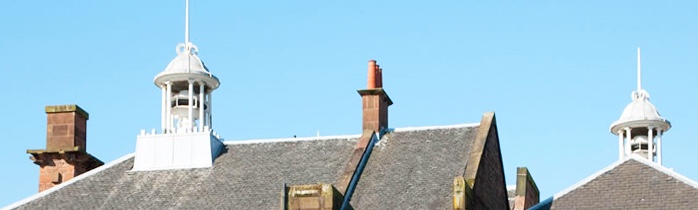
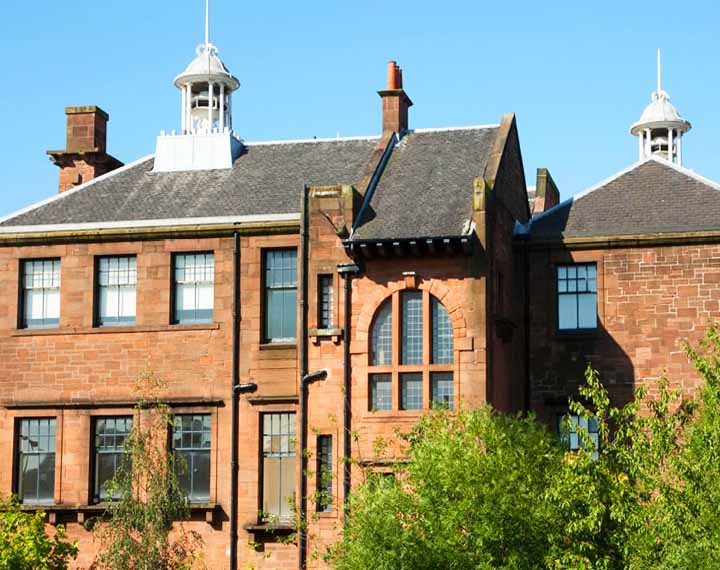
Martyrs’ School was design by the city’s famous architect Charles Rennie Mackintosh and built in 1895. More recently, the landmark was almost demolished to make way for a motorway. However, after much protest, the planners were forced to divert the motorway and this important building was saved for future generations. Nestled in Glasgow’s gritty Townhead district on Parson Street, the Martyrs’ School stands as a striking red sandstone edifice, completed in 1898 under the design of Honeyman and Keppie, with Charles Rennie Mackintosh’s emerging genius etched into its every detail. Commissioned by the School Board of Glasgow in response to the 1872 Education Act, this Category A-listed building was meant to serve the bustling tenement community, its solid form topped by ornate ventilators that nod to Scotland’s Renaissance heritage.
Though now marooned above a roaring motorway after urban clearances, it evokes the spirit of a bygone era, where education promised escape from the shadows of poverty and industrial toil. Mackintosh’s touch shines through in the subtle flourishes—the intricate ironwork on separate boys’ and girls’ entrances, the light-flooded central hall with its soaring truss roof, and the geometric grilles on windows that hint at his Art Nouveau leanings yet to fully bloom. Born just down the same street in 1868, Mackintosh infused the structure with personal resonance, blending practical schoolyard needs with artistic whimsy, like the rose motifs echoing Glasgow’s emblematic grit. For decades, it hummed as a non-denominational beacon, educating generations amid the Covenanters’ somber legacy—the “martyrs” of its name recalling executions on nearby Gallowgate for religious defiance.
Today, the school’s fate hangs in transformation, sold in 2025 by Glasgow City Council to the Bishops’ Conference of Scotland for a modest £250,000, earmarked for a £1.75 million refurb into a museum of Catholic archives brimming with artworks and relics. Once an arts hub under Glasgow Museums and a quiet annex for social services, it now promises rebirth as a cultural vault, safeguarding Scotland’s spiritual stories while honoring Mackintosh’s blueprint. In Glasgow’s ever-shifting skyline, Martyrs’ endures not just as stone and memory, but as a testament to how architecture can cradle both the past’s echoes and tomorrow’s quiet revolutions.



 Own or work here?