

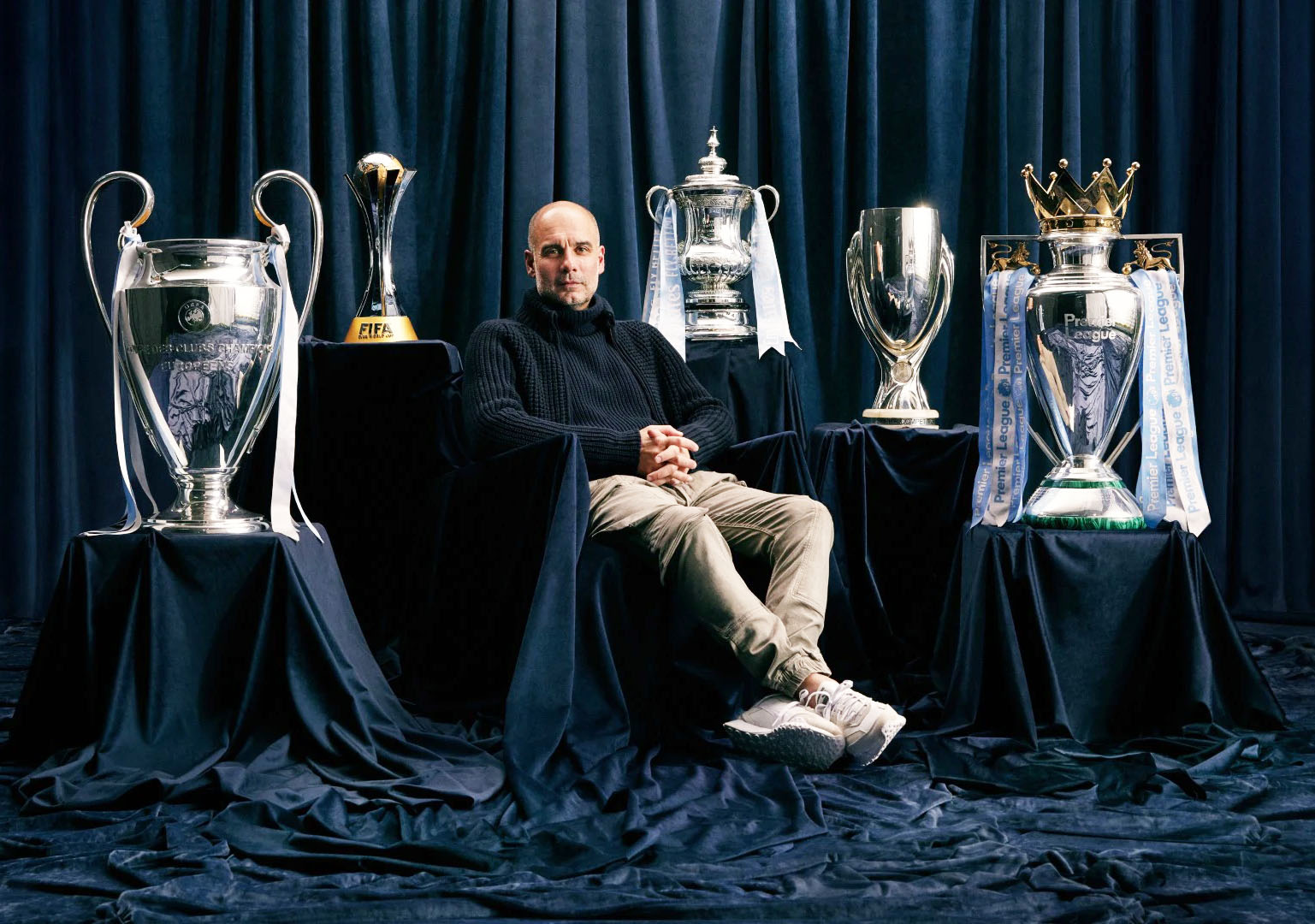
There are managers who win trophies, and there are managers who build dynasties. And then, once in a generation if football is truly blessed, there arrives someone who does something altogether more profound — someone who doesn’t merely succeed at a football club but transforms it from the inside out, rewrites what is considered possible within it, and leaves it permanently, irrevocably changed. Josep Guardiola walked through the doors of the Etihad Stadium in the summer of 2016 as the most studied, most imitated football manager alive — already a legend from his years at Barcelona and Bayern Munich — and what followed over the next ten extraordinary years was not simply the continuation of a brilliant career. It was the composition of an entirely new chapter in English football’s story, one that will be read and referenced and marvelled at for generations.
The scale of what he achieved defies easy summarising, but the facts alone are staggering enough to demand silence and reflection. In his decade at Manchester City, Guardiola claimed six Premier League titles, one Champions League, three FA Cups, five League Cups, one UEFA Super Cup, and one FIFA Club World Cup — a haul of 17 major trophies that makes him the most decorated manager in the club’s entire history. He arrived and immediately began reshaping the very DNA of English football, demanding a style, an intensity, and a depth of collective tactical intelligence that the league had never previously encountered. In 2017-18, City accumulated a record 100 Premier League points — the Centurions — becoming the first team in English top-flight history to reach that landmark. In 2018-19, he made history again, guiding City to the domestic treble — Premier League, FA Cup, and League Cup — the first English club ever to achieve the feat. Four consecutive league titles between 2020 and 2024 announced a sustained, architecturally deliberate dominance that no club in the modern era had come close to matching. And then Istanbul — that magnificent, cathartic night in May 2023 when Rodri’s second-half strike against Inter Milan completed the Champions League, Premier League, and FA Cup treble, making City only the second English side to achieve that particular constellation of glory, and placing Guardiola permanently and irrevocably among the all-time great managers of the world game. He departs with the highest points-per-game average of any manager in Premier League history — 2.34, standing 0.18 clear of Sir Alex Ferguson — a number that speaks to a consistency of excellence so complete, so sustained, and so utterly without peer that it challenges the very language we use to describe sporting achievement.
Yet the trophies, magnificent as they are, cannot fully contain what Guardiola gave to this club and to the city of Manchester. He gave them a footballing identity built on courage, craft, relentless movement, and a possession philosophy so ahead of its time that coaches at every level of the English game are still trying to decode and replicate it. He gave players the framework, the belief, and the collective spirit to perform at heights they had never previously imagined possible. He gave a fanbase a decade of wonder — of afternoons and evenings that felt less like football and more like watching the game reimagined by someone who genuinely understood it at a level no one else quite reached. The North Stand at the Etihad Stadium will now permanently bear his name — the Pep Guardiola Stand — a monument to a decade of genius that reshaped a city’s relationship with the beautiful game. He moves forward as Global Ambassador for the City Football Group, ensuring that his wisdom and vision will continue to shape the organisation he has served with such remarkable, joyful commitment. In his own farewell words — spoken with the warmth, the passion, and the unmistakeable personal depth that have always made him so much more than a football manager — he said simply: “Nothing is eternal, but eternal will be the feeling, the people, the memories, the love I have for my Manchester City. We worked. We suffered. We fought. And we did things our own way.”
And so, on behalf of Sheikh Mansour and the entire ownership of this extraordinary club, from Chairman Khaldoon Al Mubarak whose partnership with Guardiola built something the football world had never seen before, from every member of staff who worked alongside him at the Etihad and at the training ground, from every player whose career was elevated, sharpened, and permanently enriched by his genius — and most of all from every supporter who stood and roared and wept and celebrated through ten of the most thrilling, most beautiful, most unforgettable years in Manchester City’s history — thank you, Pep. Thank you for the hundred points. Thank you for Istanbul. Thank you for making football feel, at its very best, like art. The stand bears your name. The trophies fill the cabinet. And the football you created will live in this club’s soul forever.
On one side of the coin, Manchester City arrive at the Etihad knowing that the Premier League title is no longer theirs to claim, confirmed after a 1-1 draw at Bournemouth handed Arsenal an unassailable four-point lead. Yet this afternoon carries its own extraordinary weight. Pep Guardiola, John Stones and Bernardo Silva will each take their bow from the Etihad for the final time, bringing down the curtain on one of the most tactically dominant eras in European football. Silva, who joined from AS Monaco in 2017 and made over 450 appearances for the club, departs as one of the most intelligent and influential players of his generation. Stones, a defender who evolved from a traditional centre-back into a hybrid midfielder, fundamentally altering City’s build-up mechanics under Guardiola, exits as an icon. Together, they collected six Premier League titles, the Champions League, FA Cup and League Cup. The Etihad will want to send them off in the only way it knows — in style.
Yet the season itself has been one of contradictions for the Citizens. City finish second with 78 points from a record of 23 wins, 9 draws and 5 defeats, and have scored 69 goals, conceded just 27, and maintained a goal difference of plus 43 — a figure that underlines just how relentless their attacking output has been all season. Erling Haaland, who leads the Golden Boot race with 24 goals, has been the heartbeat of their attack, though the Norwegian powerhouse is ruled out for today’s match through injury, leaving the goalscoring responsibility in the capable hands of Egyptian forward Omar Marmoush. Rayan Cherki has been a revelation as City’s top assist provider with 11 league assists, and his creativity alongside Phil Foden and Savinho gives Guardiola’s side the ammunition to light up this farewell occasion. Rodri recently returned from a groin problem and is available for selection, adding steel and structure to the midfield for this final chapter.
On the other side, Aston Villa arrive not merely as visitors but as conquerors. In a season of breathtaking ambition, Unai Emery’s side have won the 2025-26 UEFA Europa League, defeating Freiburg 3-0 in the final in Istanbul, ending the club’s 30-year wait for a major trophy and marking Emery’s record-extending fifth Europa League title. Goals from Youri Tielemans, Emiliano Buendía, and Morgan Rogers secured the victory in a dominant, composed performance. That triumph in Istanbul follows hard upon a 4-2 victory over Liverpool that sealed Champions League football for next season, with Ollie Watkins, Rogers and McGinn all amongst the goals. The very spine of this Villa side pulses with confidence, togetherness and a belief that the stars are finally, truly aligned over B6.
When these two teams met at Villa Park in October, Matty Cash’s brilliant first-half goal earned Villa a 1-0 victory — their third successive home win over Guardiola’s side. City were stifled by a perfect Villa game plan, with Erling Haaland stopped from scoring for just the second time in all competitions that season — ending a 12-game scoring streak. The match stats told a story of their own: City managed 18 shot attempts to Villa’s 9, yet Villa’s goalkeeper Emiliano Martínez made only 2 saves — a testament to the defensive structure that Emery has engineered so meticulously. Villa’s xG in that meeting was just 0.81 compared to City’s 1.18, yet the clean sheet stood firm. Emery’s tactical precision in neutralising City’s world-class striker remains one of the coaching achievements of the season.
The injury news adds a fascinating layer of intrigue to the afternoon’s proceedings. Alongside Haaland, City are without Nico O’Reilly, Mateo Kovacic and Max Alleyne, while Villa carry their own absentees into this curtain-raiser. Youri Tielemans, Boubacar Kamara and Amadou Onana are doubts or ruled out for the visitors, depriving Villa of midfield dynamism at the very moment their squad might be running on emotional adrenaline alone. Despite those absences, players like McGinn, Rogers and Buendía have already shown this season that their collective spirit can transcend any personnel challenge — as Emery himself expressed immense pride in the team’s accomplishment throughout the demanding campaign.
Heading into this clash, Villa carry the most electrifying form in English football. Five consecutive victories — including a Europa League final triumph — announce a team peaking at the perfect moment. Villa’s longest winning run of the entire season stretches to 8 matches, a run that speaks volumes for the resilience, organisation and attacking coherence that Emery has cultivated over three transformative years at Villa Park. For City, meanwhile, the afternoon represents both an ending and an opportunity — to salute their departing icons with one last performance worthy of the Guardiola era. Regardless of the result, when that final whistle sounds at the Etihad, the ovation will be for more than just football. It will be for an age.
There are moments in the long and winding history of football when something shifts — when the ordinary becomes extraordinary, when a club stops simply existing and begins, with breathtaking conviction, to truly live. For Manchester City, that moment arrived on a grey September evening in 2008, carried not on the wind from the terraces of East Manchester, but in the quiet, resolute footstep of a man whose vision stretched far beyond anything the game had dared to imagine. Sheikh Mansour bin Zayed Al Nahyan did not arrive with noise or spectacle. He arrived with something infinitely more powerful — a belief so deep, so unwavering, and so magnificently ambitious that it would shake the very foundations of English football and rewrite the destiny of an entire city. He looked upon a club that had known heartbreak more intimately than glory, a club whose supporters had loved fiercely and waited long, and he did not see a struggling institution — he saw a sleeping giant, and with extraordinary grace, extraordinary generosity, and a vision that history has since proven to be nothing short of genius, he reached down and woke it. What followed was not merely a transformation. It was a resurrection. It was the most remarkable, the most uplifting, and the most inspiring story that English football has ever had the privilege of telling.
Yet no vision, however brilliant, can be realised without a leader of equal intelligence and equal conviction to carry it forward from the boardroom to the pitch, from the blueprint to the beautiful reality. That leader is Khaldoon Al Mubarak — Chairman of Manchester City and one of the most consequential, most admired and most quietly extraordinary executives in the entire history of world sport. Appointed by Sheikh Mansour at the very inception of the new era, Khaldoon Al Mubarak arrived not simply as an administrator, but as a master architect — a man of calm authority, forensic intelligence and an instinctive understanding that truly great institutions are not built on money alone, but on culture, on character and on an unshakeable commitment to excellence in every single department. It was Khaldoon who assembled the leadership structures that allowed the club to grow sustainably and intelligently, who built the commercial foundations that transformed Manchester City into a genuinely global brand, and who oversaw a programme of infrastructure investment so bold and so far-reaching that it has fundamentally and permanently altered the landscape of East Manchester. He managed the relationship between ambition and responsibility with a rare and admirable deftness, navigating the club through its most testing moments with the composure and clarity of a man who understood precisely where the club had come from, and precisely where it was destined to go. For the communities of that great city — schools supported, spaces enriched, lives quietly and meaningfully improved — his contribution extends immeasurably and permanently beyond the trophies and the glory.
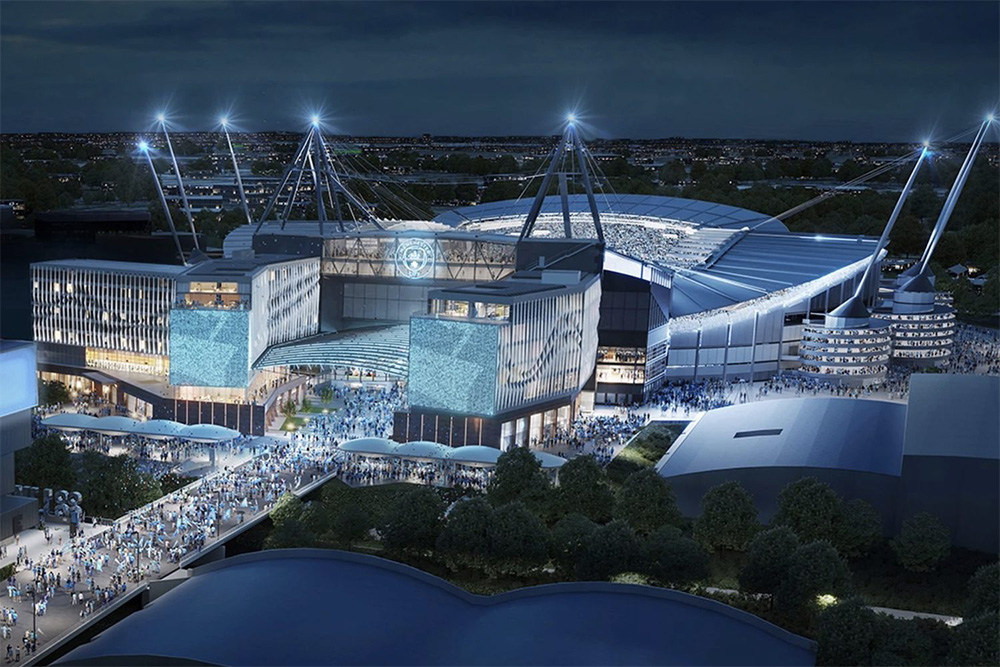
Nowhere is that contribution more visibly and more magnificently expressed than in the ongoing transformation of the Etihad Stadium itself — a project that stands as perhaps the most compelling single symbol of everything that Sheikh Mansour and Khaldoon Al Mubarak have dared to dream and delivered with such extraordinary conviction. The expansion of the North Stand, at an estimated cost of £300 million, increases the stadium’s capacity from 53,400 to nearly 62,000 spectators — but to describe this simply as a stadium expansion would be to dramatically understate the breathtaking ambition of what is being created. The project includes new commercial and entertainment buildings connected to the expanded stand, a covered fan zone with capacity for 3,000 people, new restaurants, a dedicated Manchester City museum, a new club shop and a magnificent 400-bed hotel. Above the upper tier, a sky bar with panoramic views overlooking the pitch and a stadium roof walk experience will offer supporters and visitors an encounter with this great club unlike anything previously available in English football. The new hotel — to be known as The Medlock and operated by the global hospitality group Radisson — will offer 401 rooms including luxury suites and an exclusive penthouse, making it one of the largest and most distinguished hotels in the entire region. The vision, articulated so clearly by the club’s leadership, is not simply a larger stadium. It is a year-round world-class entertainment destination — a place where the story of Manchester City can be lived, breathed and celebrated every single day of the year, by supporters and visitors from every corner of the globe. That this extraordinary undertaking is being completed at the same moment that Pep Guardiola takes his final bow feels not like coincidence, but like the most perfect and poetic of conclusions — a physical monument to an era of greatness, rising in steel and glass above the city that Sheikh Mansour and Khaldoon Al Mubarak transformed forever.
The trophies that have cascaded from this shared and magnificent vision are almost incomprehensible in their sheer and dazzling accumulation. Manchester City’s league championship history stretches back to the First Division title of 1936-37, runs through the iconic championship of 1967-68 — clinched on the final day with a dramatic 4-3 victory at Newcastle — and surges forward through eight Premier League titles that have cemented the club among the most dominant forces the modern game has ever produced. The FA Cup has been lifted eight glorious times, with the most recent triumph arriving in May 2026 when City defeated Chelsea at Wembley to complete a magnificent domestic cup double, having already secured the League Cup earlier that same season. The UEFA Champions League was conquered in 2023 — the most significant and emotionally overwhelming night in the club’s 146-year history — followed swiftly by the Club World Cup and the UEFA Super Cup, with the European Cup Winners’ Cup of 1970 standing as the first proud chapter of a continental story now reaching its most spectacular conclusion. Forty-three major trophies in total — a number that would have seemed the wild fantasy of a dreamer standing beneath the old Kippax Stand three decades ago, yet which today stands as the undeniable, deeply moving reality of what sustained vision, inspired leadership and genuine, unbreakable belief can magnificently produce.
And then there is the man who transformed all of that breathtaking potential into something that can only honestly be described as poetry. When Pep Guardiola walked through the doors of the Etihad in the summer of 2016, he arrived carrying a reputation already gilded by extraordinary success at Barcelona and Bayern Munich, regarded universally as one of the game’s supreme tactical innovators. What followed across the next ten years was something altogether more profound — a genuinely transformational reign that elevated Manchester City from wealthy and ambitious contenders into the defining, era-shaping team of their generation. The Catalan philosopher-coach did not simply orchestrate victories; he rewrote the very grammar of the game itself, his pressing systems and positional play reshaping English football from within and forcing rivals to reach levels they might never otherwise have discovered. Guardiola leaves the Etihad having accumulated 15 major trophies — among them six Premier League titles, including a scarcely believable four consecutive championships — the club’s first Champions League crown, and this season alone, both the League Cup and the FA Cup, pushing Arsenal to the very final wire of the title race with the relentless, magnificent defiance that has defined his entire tenure. He achieved all of this with the fierce and infectious joy of a man who loved football too completely, and too honestly, to ever surrender his belief in its limitless possibilities — and his deepest wish was always that what he and his players created would be remembered not merely for the relentless winning, but for the sheer, radiant, life-affirming exhilaration of how they went about it. The beautiful game, in Guardiola’s hands, was always exactly and gloriously that.
The squad he shaped and refined across this final, valedictory season speaks powerfully to the club’s undiminished ambition. Between the posts, Gianluigi Donnarumma brings the imperious authority of a goalkeeper regarded as among the finest in world football, while the defensive partnership of Rúben Dias and Marc Guehi provides the resolute, intelligent bedrock upon which everything City build is founded, with Rayan Aït-Nouri’s dynamic surging from the left flank keeping opposing defences in a state of perpetual unease. In midfield, Rodri — one of the most complete holding players of his generation on the planet — orchestrates with a composure that makes the game appear almost deceptively simple, while Tijjani Reijnders has brought a relentless energy and technical brilliance that has made him one of the Premier League’s most compelling performers. Rayan Cherki, just 22 years of age and finishing the season as the club’s leading assist provider, announces himself with every performance as a player whose most astonishing chapters are still magnificently ahead of him, and Phil Foden — as naturally gifted as any English footballer of his generation — retains that rare, irrepressible capacity to illuminate any stage he is given, while the electric pace of Savinho and the fearless directness of Jérémy Doku ensure that City’s attacking width remains among the most dangerous and exhilarating in European football. Erling Haaland — whose 24 Premier League goals once again led the division’s scoring charts — remains the most physically imposing and clinically devastating striker in world football, his shadow falling across every tactical plan that City’s opponents dare to construct even in his current absence, so absolute is his capacity to decide a match in a single, lethal and unstoppable moment, while Omar Marmoush has led the line in his place with the hunger, intelligence and sophistication of a footballer utterly determined to leave his own indelible mark upon this storied and magnificent club. As the curtain falls on the Guardiola era with today’s final whistle, and as Bernardo Silva — the captain, the heartbeat, the footballer who gave more than 450 magnificent performances, collected 19 trophies and was called truly irreplaceable by the greatest manager who ever watched him play — walks off the Etihad turf for the very last time alongside that great man himself, every soul inside this newly magnificent, expanded and reborn stadium will understand with perfect and profound clarity that what they witnessed across this extraordinary decade was not simply sport. It was art. It was courage. It was ambition — Sheikh Mansour’s ambition, Khaldoon’s ambition, Guardiola’s ambition — made gloriously, defiantly and magnificently real. It was, in the fullest and most joyful sense that the human heart can hold, a dream brought magnificently, beautifully and unforgettably to life.
Founded in 1874, Aston Villa are not merely one of England’s grand historic football institutions; they are architects of the modern game itself, a founding member of the Football League whose claret-and-blue identity has echoed across generations. Their honours tell the story of genuine football aristocracy: seven English league championships, seven FA Cups, five League Cups, the 1982 European Cup, the 1982 UEFA Super Cup, the 1981 FA Charity Shield, and now the magnificent addition of the 2025–26 UEFA Europa League crown, a triumph that signals not nostalgia, but rebirth. Villa Park remains one of football’s great theatres, where history is not displayed in glass cabinets alone—it breathes in every roar from the Holte End.
This 2025–26 Aston Villa side has embodied courage, tactical intelligence, and relentless competitive hunger under Unai Emery, transforming the club into a genuine European force once again. Securing UEFA Champions League qualification while conquering Europe’s second-greatest competition marks a campaign of extraordinary significance. The registered senior squad has blended steel, artistry, and belief through Emiliano Martínez, Robin Olsen, Ezri Konsa, Tyrone Mings, Pau Torres, Matty Cash, Lucas Digne, Ian Maatsen, Andrés García, Boubacar Kamara, Youri Tielemans, John McGinn, Jacob Ramsey, Amadou Onana, Ross Barkley, Morgan Rogers, Emiliano Buendía, Leon Bailey, Marco Asensio, Marcus Rashford, Donyell Malen, and Ollie Watkins, with captain McGinn embodying the club’s emotional heartbeat and Watkins continuing as a devastating attacking benchmark. Morgan Rogers has emerged as one of the season’s defining breakthrough forces, while Martínez remains a world-class pillar of composure and mentality.
Equal admiration belongs in the boardroom, where chairman Nassef Sawiris has helped oversee one of the most visionary transformations in modern English football. Aston Villa’s resurgence has not been accidental; it has been engineered through strategic investment, football intelligence, infrastructure ambition, elite recruitment, managerial conviction, and a commitment to deepening the club’s connection with Birmingham’s local community. The redevelopment and modernisation vision surrounding Villa Park and the broader long-term sporting project reflect ownership that understands football clubs are civic institutions as much as competitive enterprises. This is leadership with patience, scale, and imagination.
Aston Villa today stand as proof that greatness can be restored not through sentiment, but through bold vision, exceptional stewardship, and unwavering belief. What makes this renaissance so inspiring is not simply the silverware—it is the journey from uncertainty to authority, from rebuilding to belonging once again among Europe’s elite. Aston Villa are no longer speaking about ambition; they are living it.



 Own or work here?