

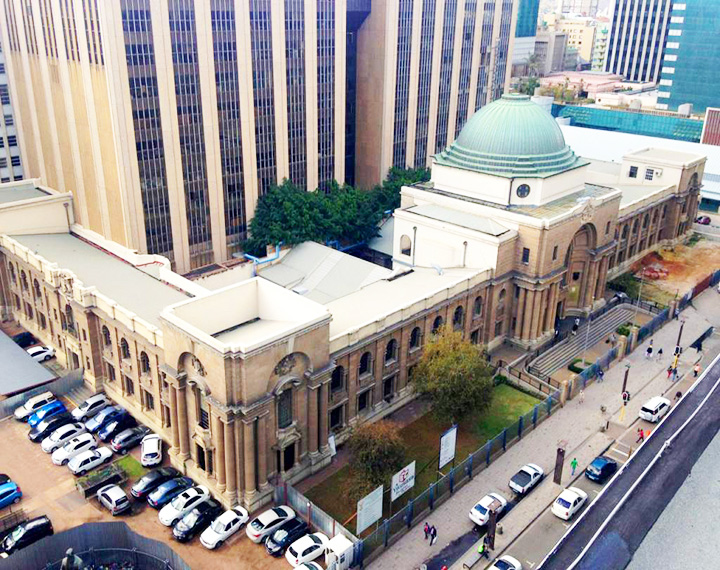
Johannesburg’s High Court, officially known as the Gauteng Division of the High Court, stands as a prominent symbol of the city’s legal and architectural heritage. Constructed in 1910, the building was designed by architect Gordon Leith in a style that blends Edwardian and Baroque influences, reflecting the grandeur of the early 20th century. Its imposing façade, featuring a domed rotunda and classical columns, commands attention in the heart of Johannesburg’s Central Business District. The structure’s historical significance is further underscored by its role in the legal evolution of South Africa, serving as a central venue for high-profile cases and legal proceedings. The High Court’s architectural design incorporates elements that were innovative for its time, with the use of reinforced concrete and steel framing allowing for expansive interior spaces and large windows that illuminate the grand courtrooms.
The building’s design not only reflects the aesthetic preferences of the era but also serves a functional purpose, facilitating the efficient administration of justice. Over the years, the High Court has undergone various renovations to preserve its structural integrity and to accommodate modern technological advancements, ensuring that it continues to meet the demands of contemporary legal proceedings. Culturally, the High Court has been a witness to significant moments in South Africa’s legal history. It has hosted numerous landmark cases that have shaped the nation’s legal landscape, including matters related to constitutional law, human rights, and social justice. The building’s role extends beyond its function as a courthouse; it stands as a testament to the evolution of South Africa’s legal system and its commitment to upholding the rule of law.
For visitors interested in the architectural and historical aspects of Johannesburg, the High Court offers a glimpse into the city’s rich legal heritage. While access to the interior is typically restricted to legal professionals and those with official business, the exterior of the building can be appreciated from the surrounding streets. Its proximity to other notable landmarks, such as Constitution Hill and the Old Fort, makes it a part of a broader exploration of Johannesburg’s historical and cultural sites. In summary, Johannesburg’s High Court is more than just a functional legal institution; it is a significant cultural and historical landmark. Its architectural grandeur, combined with its pivotal role in the nation’s legal history, makes it a noteworthy point of interest for those seeking to understand the complexities of South Africa’s journey through the 20th and 21st centuries.



 Own or work here?