

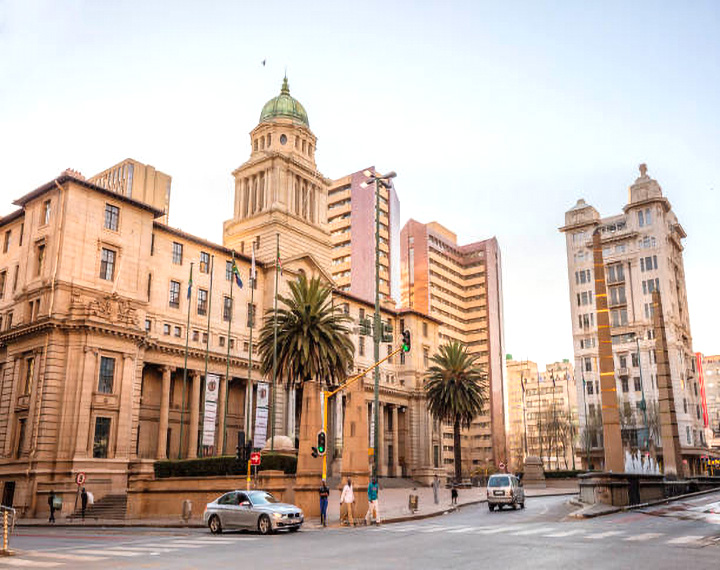
Johannesburg City Hall stands as a monumental testament to the city’s rich history, culture, and architectural grandeur. Completed in 1914, this Edwardian Baroque structure was designed by the Cape Town firm Hawke & McKinley and constructed by Mattheus Meischke at a cost of £503,000. Its inauguration in 1915 marked a significant milestone in Johannesburg’s urban development. Recognized for its importance, the building was declared a National Monument in 1979, underscoring its architectural and historical significance. The design of Johannesburg City Hall is a harmonious blend of Edwardian Baroque and Neo-Renaissance elements. Its façade features Ionic columns and a grand half-dome entrance, leading to a marble-clad vestibule and a council chamber with a domed ceiling adorned with intricate plasterwork.
The exterior is clad in Free State Flatpan Freestone, transported to Johannesburg by ox wagon, adding to its historical charm and sense of grandeur. Beyond its architectural beauty, the City Hall has played a pivotal role in South Africa’s political history. In 1992, it served as a voting station during the national referendum that helped pave the way for the end of apartheid. In earlier decades, the hall’s steps were frequented by activists and political figures, including Nelson Mandela, who engaged in public debates and protests against apartheid policies, making it a symbol of civic resistance and political engagement. Culturally, the City Hall has long been a hub for artistic and musical events. Its grand organ, once the largest in Africa, hosted numerous recitals and concerts, contributing to Johannesburg’s vibrant cultural scene.
Today, while the building houses the Gauteng Provincial Legislature, it continues to represent the city’s rich cultural and historical legacy. Located in the heart of Johannesburg’s Central Business District, the City Hall is surrounded by other notable landmarks, including the Rissik Street Post Office and the Rand Club. Visitors can admire its exterior and explore the nearby Beyers Naudé Square, which provides a window into the city’s architectural evolution. Johannesburg City Hall is more than just a building; it is a living testament to the city’s journey through colonialism, apartheid, and democracy, making it an essential destination for anyone seeking to understand the cultural and historical fabric of South Africa.



 Own or work here?