

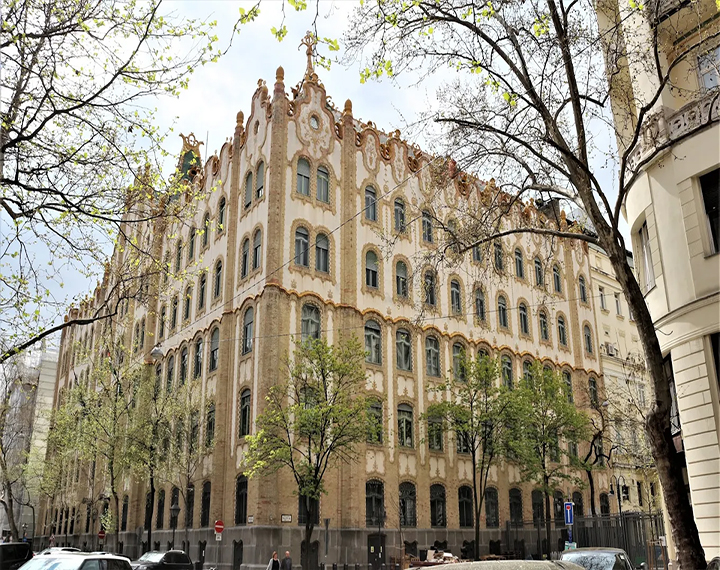
The Hungarian State Treasury, originally built as the Royal Postal Savings Bank, is a breathtaking masterpiece located on Hold utca in the heart of the Lipótváros district. This building is widely considered the most beautiful example of the “Hungarian Secession” style, radiating an atmosphere of vibrant creativity and national pride. Its most striking feature is the dazzling roof of green and gold Zsolnay ceramic tiles, which forms an intricate pattern that seems to dance under the Budapest sun, inviting every passerby to look up in wonder.
Culturally, the building serves as the ultimate expression of architect Ödön Lechner’s quest to create a uniquely Hungarian architectural language. It is famously adorned with charming ceramic bees climbing toward golden beehives on the roof, a playful symbolic tribute to the virtues of thrift and hard work associated with a savings bank. The structure is a vital part of the city’s artistic identity, blending traditional folk motifs with the fluid, organic lines of Art Nouveau, and it stands as a testament to the sophisticated “Szecesszió” movement that flourished at the turn of the century.
Historically, the palace was completed in 1901 during a period of immense economic and cultural expansion in the Austro-Hungarian Empire. Lechner designed the building with the “poor grandmother from the countryside” in mind, wanting to create a space that felt both welcoming and prestigious for everyday citizens entrusting their savings to the state. Despite the passage of time and the scars of various conflicts, the building has been meticulously preserved and restored, continuing to function as a government institution while remaining a cornerstone of Hungary’s architectural heritage.
Tourists and architecture enthusiasts find the Treasury to be an uplifting highlight of any walking tour through the Fifth District, often stopping to marvel at the intricate floral gargoyles and the colorful mosaics that decorate the facade. While the interior is used for administrative purposes, the exterior remains one of the most photographed and beloved sights in the city, especially when viewed from the surrounding streets where the light hits the iridescent Zsolnay tiles. It is a beautiful reminder that even the most formal of institutions can be housed in a work of pure, imaginative art.



 Own or work here?