

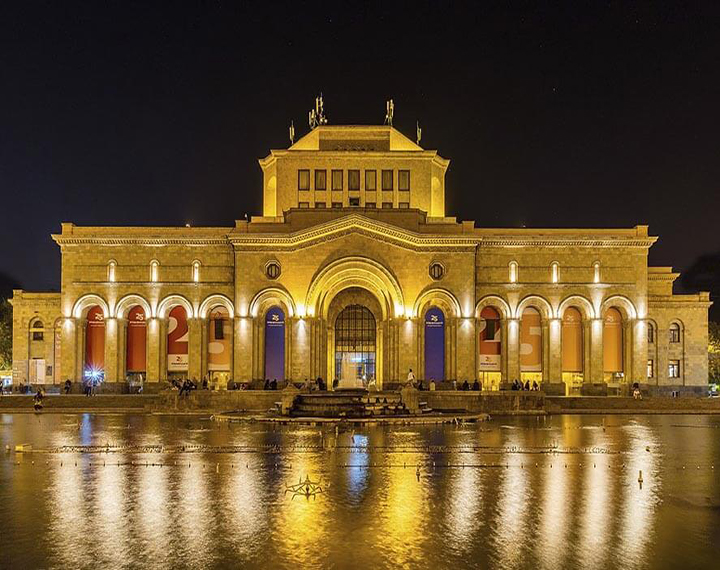
The History Museum of Armenia stands as the nation’s premier historical institution, occupying a grand neoclassical building on Republic Square that serves as the guardian of over four hundred thousand artifacts. The museum offers an atmosphere of profound reverence and discovery, with galleries that lead visitors on a chronological odyssey from the Stone Age to the contemporary period. It is world-renowned for housing the oldest leather shoe in the world, discovered in the Areni-1 cave, as well as a stunning collection of Urartian bronze works and medieval cross-stones known as khachkars. The museum’s scholarly yet inviting ambiance makes it an essential pilgrimage for anyone seeking to understand the foundational roots of the Caucasus and the enduring legacy of the Armenian people through the millennia.
The History Museum of Armenia in Yerevan serves as a vital repository of the nation’s material culture, tracing Armenian history from prehistoric times to the present day. Its extensive collections, which include archaeological finds, ethnographic materials, coins, and medieval manuscripts, offer a comprehensive overview of the region’s ancient civilizations, such as the Urartian kingdom. Among the most prized possessions are artifacts from the Erebuni fortress and the medieval capital of Ani, demonstrating the advanced metalwork, architecture, and artistic traditions that flourished on the Armenian Highlands for millennia.
Visitors to the museum can journey through well-organized chronological halls that highlight key turning points in Armenian statehood, including the adoption of Christianity as a state religion in the early fourth century. Exhibits also cover periods of foreign domination, the struggle for national liberation, and the brief independence of the First Republic of Armenia (1918–1920). The museum does not shy away from more difficult chapters, such as the intellectual and cultural revival of the 19th century and the tragic events of the Armenian Genocide, which are contextualized within the broader narrative of survival and resilience.
Beyond its historical artifacts, the museum also celebrates Armenian cultural identity through displays of traditional carpets, clothing, and religious art, including finely carved khachkars (cross-stones). Modern additions showcase aspects of Soviet-era life and the eventual reestablishment of sovereignty in 1991. By preserving and interpreting these diverse threads, the History Museum of Armenia provides an essential understanding of how a small, ancient nation has maintained its distinct language, faith, and customs through centuries of change and challenge.



 Own or work here?