

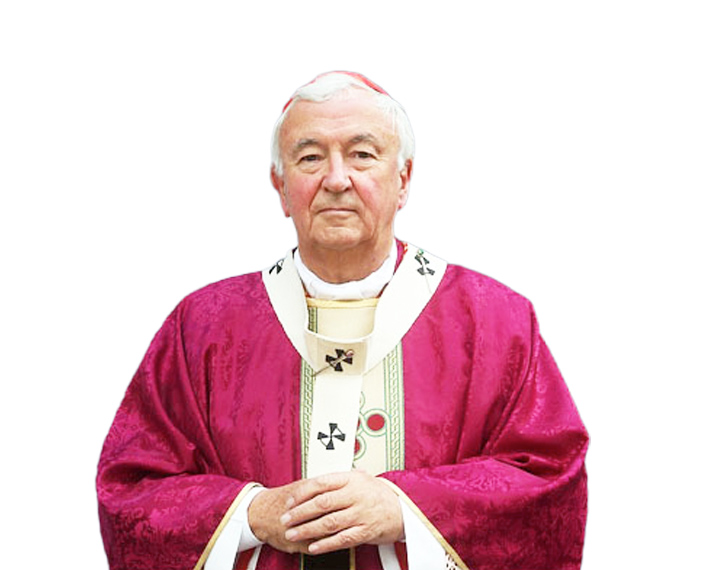
Born on 8 November 1945 in Crosby, a modest suburb of Liverpool, Vincent Gerard Nichols grew up in an ordinary working-class Catholic family during the post-war years. The son of two teachers, he learned early that faith was not a private sentiment but a daily practice of kindness, honesty, and service. As a boy he served at the altar, played football in the street, and absorbed the resilient spirit of Merseyside Catholicism that would shape his entire life.
He entered St Mary’s College, Oscott, to train for the priesthood and was ordained in Rome on 21 December 1969, the very year the Second Vatican Council’s vision of a Church fully engaged with the modern world was still taking root. From his first parish assignments in the tough dockland areas of Liverpool, Vincent showed the hallmark that would define his ministry: he listened before he spoke, walked the streets before he preached from the pulpit, and never forgot the smell of ordinary homes.
In 1984, at only 38, he was chosen as General Secretary of the Catholic Bishops’ Conference of England and Wales—an administrative role that could have buried a lesser man in paperwork. Instead, he used it to become the quiet architect of the Church’s response to the great social questions of the 1980s and 1990s: AIDS, homelessness, the collapse of heavy industry, and rising secularism. Colleagues still remember how he would finish late-night meetings and then drive through the night to be with a dying priest or a struggling family.
Appointed Archbishop of Birmingham in 2000, he inherited a diocese wounded by the child-abuse scandals of previous decades. With characteristic courage and transparency, he met victims personally, wept with them, apologized without qualification, and introduced some of the most rigorous safeguarding measures in the world—measures later adopted nationally. It was painful, humbling work, but he insisted that only truth could heal, and only humility could restore trust.
In 2009 Pope Benedict XVI called him to Westminster, the mother diocese of Catholics in England and Wales. On the day of his installation at Westminster Cathedral, he stood before thousands and spoke not of triumph but of pilgrimage: “We walk together, wounded but hopeful, carrying the light of Christ into a world that needs it more than ever.”
The Archbishop of Westminster is the head of the Roman Catholic Archdiocese of Westminster and, by long-standing tradition, the leader of the Catholic Church in England and Wales. His full title is **His Eminence the Cardinal Archbishop of Westminster**. The present holder of the office is Cardinal Vincent Nichols (born 1945), who has served since 2009 and was created cardinal by Pope Francis in 2014. Importantly, he has no jurisdiction over Westminster Abbey, which is an Anglican (Church of England) foundation; his cathedral is the distinct and much larger **Westminster Cathedral** in Victoria, London, the mother church of English and Welsh Catholicism.
As ordinary of the largest Catholic diocese in the country, the archbishop is directly responsible for the pastoral care of roughly 450,000 Catholics across Greater London north of the Thames and the Home Counties. His day-to-day duties include ordaining priests, confirming the faithful, visiting parishes and schools, overseeing diocesan finances, and ensuring rigorous safeguarding standards. As Metropolitan of the Province of Westminster, he also has limited canonical oversight of the four suffragan dioceses (Brentwood, East Anglia, Northampton, and Nottingham).
Nationally, the archbishop serves as President of the Catholic Bishops’ Conference of England and Wales, making him the principal public voice of Catholicism in both countries. In this capacity he speaks on moral and social issues, meets regularly with government ministers, represents the Church at state occasions, and fosters relations with other Christian denominations and faiths. As a cardinal he remains a member of the universal College of Cardinals, eligible (until he turns 80 in November 2025) to enter a conclave to elect a new pope. In short, the Archbishop of Westminster combines the roles of chief pastor of a major diocese, national spokesman for two million Catholics, and senior figure in the worldwide Church.



 Own or work here?