

Construction started on Hadrian’s Wall around AD 122, as part of Hadrian’s strategy of strengthening the north-west frontiers of the empire. Typically, Roman frontiers, such as the system around the Stanegate, consisted of large military bases and smaller outposts at important locations, joined by roads to allow swift communications. The landscape was monitored but not closed off to all travel. Smuggling or small-scale raiding was still feasible in bad weather or at night, although larger attacks could be dealt with by the garrisons stationed at the forts.
Hadrian, however, ordered the construction of a continuous wall and V-shaped ditch north of the Stanegate, running 80 Roman miles (73 miles) from Wallsend on the eastern coast to Burgh-by-Sands on the Solway Firth. This effectively closed the frontier, preventing uninhibited and unmonitored access to the province. The western end of the Wall (the 30 or so miles west of the river Irthing) was initially built of turf, but was replaced in stone later in Hadrian’s reign.
The Wall was heavily fortified with military installations roughly every 500 metres along its length. Small forts, known as milecastles, were spaced about a Roman mile apart, and housed garrisons of up to about 30 soldiers. Positioned at equal distances between each pair of milecastles were two turrets, providing further vantage points from which to monitor the landscape.
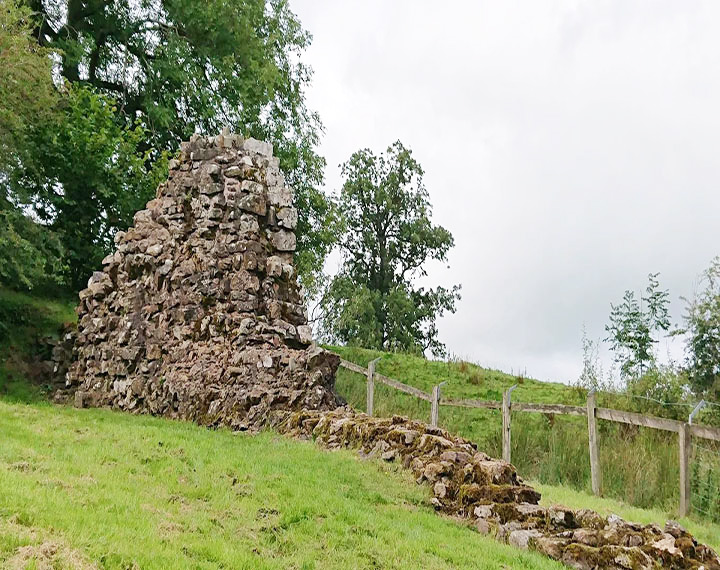
Hare Hill in Cumbria is the tallest remaining stretch of Hadrian’s Wall, standing up to 3 metres high. It probably survived because it was later built into the wall of a medieval structure. In the 19th century it was substantially rebuilt, using Roman masonry which was probably retrieved from the surrounding area.



 Own or work here?