

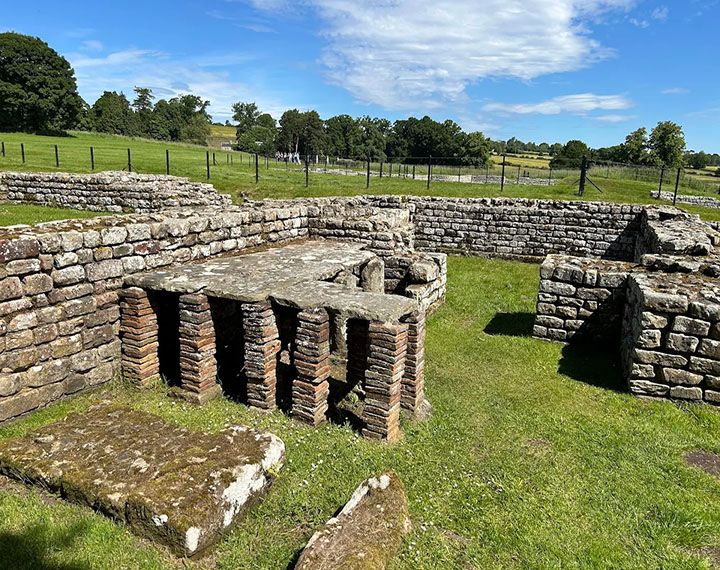
Follow in the footsteps of Romans and trek alongside an ancient monument on a coast to coast walk across northern England. Hadrian’s Wall is a historic Roman fortification built nearly 2,000 years ago across northern England. Commissioned by Emperor Hadrian around AD 122, it marked the northern boundary of the Roman Empire in Britain. Stretching about 73 miles from the River Tyne near Newcastle in the east to the Solway Firth on the west coast, the wall was constructed to control movement and defend Roman territory from northern tribes.
More than just a wall, this ancient frontier included forts, milecastles, turrets, and watchtowers, forming a sophisticated defense system. Roman soldiers were stationed along the wall to patrol and monitor the area, ensuring the empire’s security while also facilitating trade and communication.
Today, Hadrian’s Wall is a UNESCO World Heritage Site and one of Britain’s most celebrated archaeological landmarks. Visitors can walk along its remains, explore forts and museums, and enjoy scenic views of the surrounding countryside. The wall represents both the engineering skill of the Romans and a lasting symbol of Britain’s rich history.
The Trail is 84 mile (135 km) long. If you are an experienced walker then we generally recommend allowing 6 or 7 days to complete the whole Trail, although you might want to allow some extra time to visit some of the Roman sites that you pass. They all have museums with interpretive displays and they also provide refreshments.
Anyone who is reasonably fit should be able to walk the Hadrian’s Wall Path although it is not an easy walk. Some guidebook and magazine articles have described the Trail as “not a challenge walk” but it is more difficult than many people imagine it to be. The 23 mile (37 km) section between Chollerford and Birdoswald is a switchback with lots of short climbs and descents; it is a bit like walking along the coast. The majority of the path has a natural grass surface; only the Tyneside section is tarmac.
Navigation is not difficult. The route is very clearly marked with the acorn symbol as well as way marking arrows. Even poor visibility in the higher central section should not present too many problems, here the path is alongside either Hadrian’s Wall itself, a modern field wall or the humps and bumps in the ground of archaeological earthworks. It is always a good idea though, to track your progress on your guidebook or map.
This coast-to-coast traverse across northern England explores a dramatic and diverse region – with the famous World Heritage Site of Hadrian’s Wall at its heart. Passing Roman settlements and forts, there’s ancient history and great views every step of the way.



 Own or work here?