

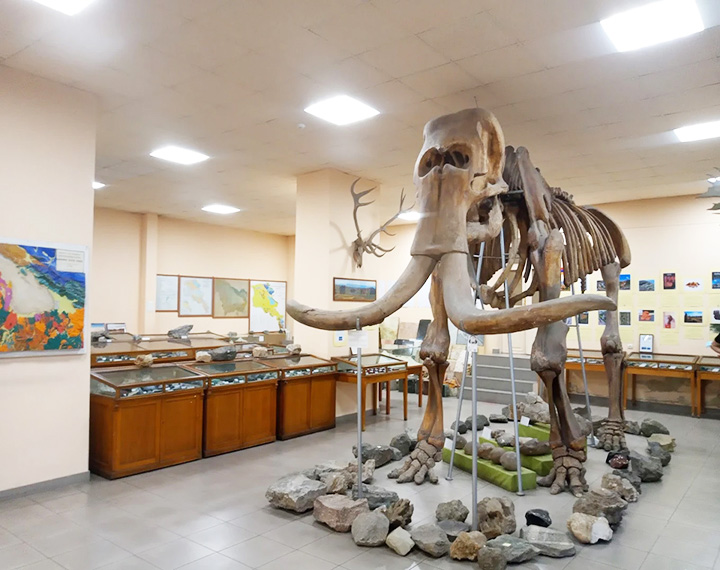
The Geological Museum Named after H. Karapetyan is a prestigious sanctuary of science founded in 1937. This world-class institution houses approximately 12,000 exhibits across sections dedicated to paleontology, volcanology, and mineral resources. A centerpiece of its magnificent collection is the restored skeleton of a prehistoric elephant discovered in Gyumri, standing as a monumental testament to the region’s ancient biodiversity. The museum serves as a cutting-edge lighthouse for geological research, reflecting the rich structure and mineral wealth of Armenia’s lithosphere, and providing an inspiring environment for those seeking to understand the deep history of the Caucasus.
The Geological Museum of Armenia, located in the heart of Yerevan, offers a profound journey into the planet’s deep past, with a special emphasis on the rich and diverse geology of the Armenian Highlands. Housing over 12,000 specimens, the museum’s collections range from rare minerals and shimmering crystalline formations to ancient fossils and volcanic rocks that tell the story of a landscape shaped by powerful tectonic and magmatic forces. Visitors are immediately struck by the vibrant colors and intricate structures of native ores, agates, and obsidian, which highlight Armenia’s position as a natural laboratory for studying both mountain-building processes and mineral wealth.
The museum’s exhibits are systematically arranged to illustrate key geological principles, including stratigraphy, paleontology, and petrology, with a focus on the local Mesozoic and Cenozoic eras. Among the most prized displays are perfectly preserved ammonites, belemnites, and fossilized flora that once thrived in ancient seas and forests now uplifted into the Lesser Caucasus range. The collection also emphasizes the region’s metallogenic history, showcasing copper, molybdenum, and iron ores that have been exploited since the Bronze Age, thereby connecting natural history with the development of early Armenian civilizations.
Beyond its scientific value, the Geological Museum serves as an educational gateway for students, researchers, and curious travelers seeking to understand how Armenia’s dramatic topography—dominated by Mount Aragats, volcanic plateaus, and deep river canyons—directly influences its ecosystems and human settlement patterns. Informative placards in Armenian and English provide clear explanations of rock formation processes, seismic activity, and the ongoing influence of volcanic hotspots. A visit to this understated yet indispensable institution leaves one with a deep appreciation for the slow, powerful forces that have not only built the Armenian landscape but also shaped the natural resources and geological hazards that continue to define life in this ancient land.



 Own or work here?