

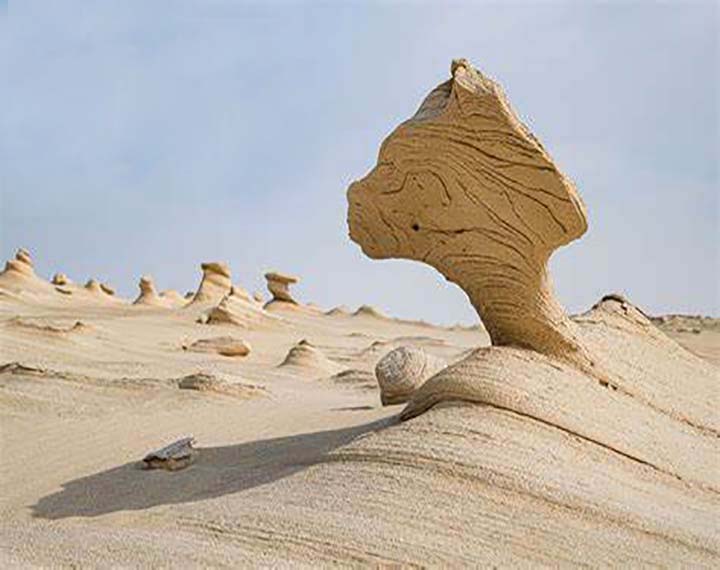
Sand dune formation is controlled by a combination of wind strength and direction, and sediment supply. In detail, however, the formation of dune patterns remains poorly understood. Within a given area the dune pattern may be quite regular, but also intricate. Physical features are typically created on several different scales – giant sand ridges on a scale of hundreds of metres to a few kilometres, sand dunes measured in metres to tens of metres, and ripples on a scale of centimetres to a metre or more. This hierarchy can be readily observed in the deserts of the UAE.
Since dune patterns vary with wind direction, seasonal or occasional variations in wind direction introduce new elements into the overall pattern. These elements may reinforce or cancel each other, in the same manner as ocean waves. In addition, because sand dunes cannot move or change as quickly as ocean waves, past history may play a significant part in what we see today. Despite relatively consistent prevailing wind directions in the present day UAE, dune patterns and alignment vary considerably from area to area.



 Own or work here?