



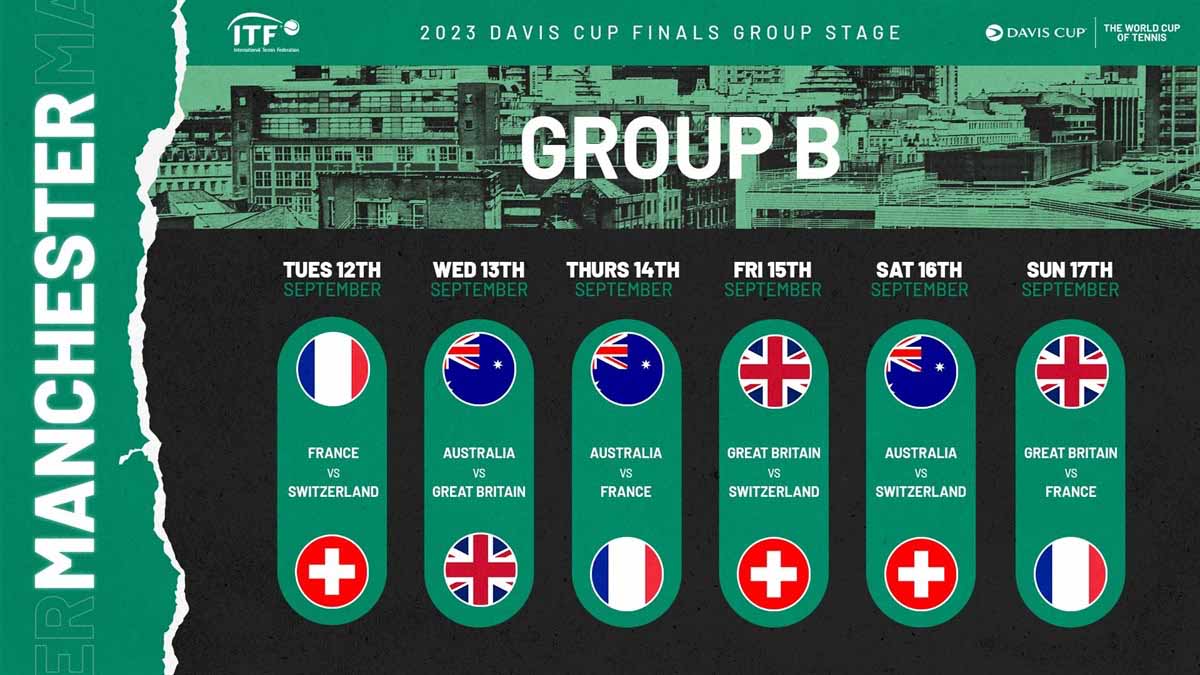
Davis Cup began in 1900 as a competition between the USA and Great Britain. It’s now the world’s largest annual international team competition in sport, with 155 nations entering in 2023.
Concept
The first Davis Cup took place in 1900 and saw the USA take on Great Britain, then playing under the name of the British Isles. It was held at the Longwood Cricket Club in Boston and the Americans surprised their opponents by racing into an unassailable 3-0 lead.
The idea of the Davis Cup was conceived a year earlier by four members of the Harvard University tennis team, who wished to set up a match between USA and Great Britain. Once the two respective national associations had agreed, one of the four players, Dwight Davis, designed a tournament format and ordered a trophy, buying it with his own money.
The tournament was originally known as the International Lawn Tennis Challenge but soon became known as Davis Cup after Dwight Davis’s trophy, which was designed by William Durgin and crafted by Rowland Rhodes.
Early years
In 1905, the Davis Cup expanded to include France, Austria, Belgium and Australasia, a combined team of players from Australia and New Zealand. Then by the 1920s, there were over 20 nations regularly playing in the competition.
The early years were dominated by the USA, Great Britain and Australasia, but that period was ended in 1927 by France. Led by the famous Four Musketeers – Jean Borotra, Jacques Brugnon, Henri Cochet and Rene Lacoste – France embarked on a glorious run of wins that lasted six years.
USA, Great Britain and Australia took control again from the 1930s and it wasn’t until the 1970s that any other nation triumphed. During this time, Australians Harry Hopman and Roy Emerson both entered the Davis Cup history books for winning more titles as captain and player respectively – Hopman won 16 and Emerson won eight.
Competition expands
In 1969, a year after the start of the Open Era in tennis, 50 nations competed in Davis Cup for the first time. Then in 1972, the competition underwent a major change of format as the Challenge Round was abolished, resulting in the reigning champion having to play in every round, rather than gaining a bye directly into the Final.
In the same year, Nicola Pietrangeli played his last tie for Italy. He enjoyed a distinguished career and still holds many Davis Cup player records, including the most rubbers played, 164, and the most rubbers won, 120.
In 1974, South Africa became the fifth nation to lift the trophy and was quickly followed by Sweden, Italy and Czechoslovakia, as the competition grew in popularity around the world.
World Group begins
In 1981, the Davis Cup format was changed to create a 16-nation World Group. The remaining nations were split into regional Zone Groups with promotion and relegation up for grabs.
This year also marked the start of a commercial partnership with NEC, the competition’s first Title Sponsor, which allowed for prize money to be given.
BNP Paribas took over from NEC as the competition’s Title Sponsor in 2002, before ending their agreement in April 2019.
The 1980s saw a new era of Swedish players winning three titles and Germany also began an impressive six-year spell that saw it triumph on three occasions. In 1993, the Davis Cup welcomed 100 nations for the first time.
The competition celebrated its 100th Final in 2012, which also marked the start of the ITF’s Centenary Year. The final also saw the launch of the Davis Cup Commitment Award to recognise long-standing dedication.
 Own or work here?
