

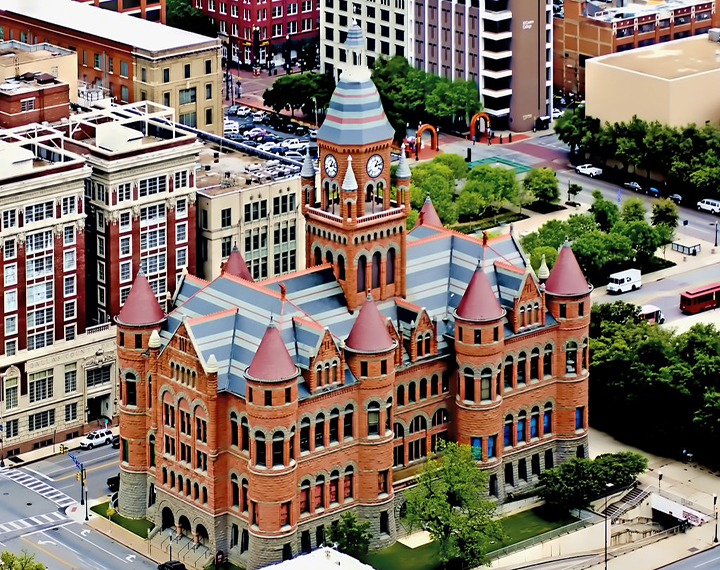
Rising from the heart of downtown Dallas with the imperious authority of a medieval citadel, the Dallas County Courthouse — beloved by generations as simply “Old Red” — stands as the most dramatic and storied building in all of Texas. Completed in 1892 at a cost that stunned even the ambitions of a rapidly expanding frontier city, this magnificent structure was born of both necessity and pride. Four of Dallas County’s five previous courthouses had been consumed by fire, and when commissioners opened bids for a new building, they were determined this one would endure. Designed by Arkansas architect Max A. Orlopp Jr. in the grand Richardsonian Romanesque style — that great nineteenth-century American movement that looked to the rounded arches and muscular stonework of eleventh and twelfth century Europe — Old Red was constructed from deep red sandstone quarried in Pecos County and polished blue granite from the Texas Hill Country, materials chosen as much for their fireproof resilience as for their extraordinary beauty.
The building that rose on South Houston Street was nothing short of astonishing. Its towers soared, its arches swept with breathtaking confidence, and its clock tower — a ninety-foot crown that made Old Red the undisputed sovereign of the Dallas skyline — chimed across a city that was still finding its identity as a rail hub and commercial powerhouse of the American South. The interior was equally magnificent: six fully appointed courtrooms, a cast-iron grand staircase of remarkable elegance, soaring vaulted ceilings, and decorative lunettes of vibrant stained glass that bathed the hallways in warm, jewelled light. Terra cotta wyverns — those winged, two-legged serpents of medieval heraldry — perched at each corner of the roofline, silent guardians of justice watching over a city growing faster than anyone had dared to imagine.
The building’s long life has not been without drama. By 1919, structural instability forced the removal of the beloved clock tower, robbing Old Red of its crown and leaving it, as one observer memorably wrote, like a twelfth-century royal without a diadem. Decades of modification and neglect followed — office conversions, ill-judged renovations, and finally, in 1967, a wholesale remodelling into a welfare department office — that stripped away much of the interior’s historic integrity. Yet the building refused to surrender its magnificence, and by the 1980s a movement had grown to restore and honour it properly. The painstaking, multi-phase restoration completed in 2007 returned Old Red to something close to its original glory, with the clock tower rebuilt to its full ninety-foot height, all four clock faces lit from within so that the structure glows golden against the Dallas night sky, and the grand staircase faithfully recreated from ghosted impressions found on the original walls.
From 2007 the building served as home to the Old Red Museum of Dallas County History and Culture, its galleries chronicling the sweep of the county’s story from prehistoric times through the rise of industry, the civil rights era, and the city’s emergence as a global metropolis. That chapter has now closed with equal distinction: as of 2024, Old Red has returned to its original civic purpose, now housing the Texas Fifth Circuit Court of Appeals, and justice once again fills its magnificent rooms. The building stands in one of the most historically charged precincts in all of America — directly overlooking Dealey Plaza, where President John F. Kennedy was assassinated in November 1963, and adjacent to the Sixth Floor Museum and the John F. Kennedy Memorial Plaza. To stand on Old Red’s front steps is to occupy one of the great intersections of American history, where the nineteenth and twentieth centuries meet in a single, extraordinary view.



 Own or work here?