

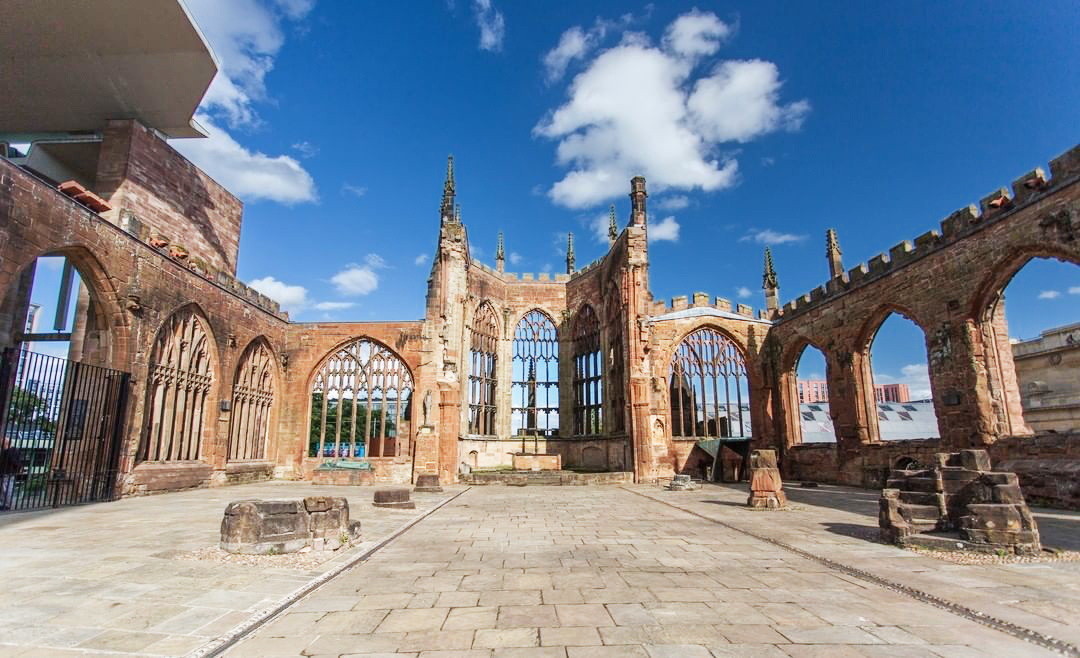
A Beacon of Renewal and Reconciliation. In the heart of Coventry, West Midlands, England, stands the Cathedral Church of Saint Michael—affectionately known as Coventry Cathedral—a profound testament to humanity’s capacity for healing and hope. As the spiritual heart of the Diocese of Coventry within the Church of England, it serves as the seat of the Right Reverend Sophie Jelley, the tenth Bishop of Coventry, who brings fresh vision and passion for reconciliation since her installation in spring 2025. Under the inspiring leadership of The Very Reverend John Witcombe, Dean since 2013, the Cathedral continues to weave its ancient legacy with contemporary outreach, fostering arts, inclusion, and global peace initiatives.
Our doors swing open daily, year-round, inviting wanderers, seekers, and worshippers alike to step into a sacred space alive with possibility. Join us for daily services—streamed live on Facebook for those afar—or simply pause in reflection amid our ruins and modern marvels. Entry remains free, a deliberate choice to democratize the divine, but your generous donations sustain this welcome. Through Gift Aid, every pound you give stretches to £1.25, fueling our mission to remain a haven for all.
Prepare to be moved: Coventry Cathedral is more than stone and stained glass—it’s a living epic of resilience, where history whispers of loss and rebirth, and culture pulses with the rhythm of redemption. Over nearly a millennium, Coventry has birthed three cathedrals, each a chapter in a saga of destruction and defiant renewal, mirroring the city’s own indomitable spirit—from medieval prosperity to wartime ashes, and now to a global beacon of unity.
Our story ignites in 1043, when Leofric, Earl of Mercia, and his legendary wife Lady Godiva—forever etched in folklore for her bold ride through Coventry’s streets—founded a Benedictine priory dedicated to St Mary. Rising from the ashes of an ancient Saxon nunnery (razed by Viking invaders under King Canute around AD 1016), this grand edifice symbolized Coventry’s ascent as a medieval powerhouse. Spanning an awe-inspiring 142 yards, with soaring Norman, Romanesque, and Gothic flourishes added over centuries, it drew pilgrims and prospered amid the wool trade’s riches. Godiva’s legacy endures in the nearby Godiva Clock, a whimsical 1950s tribute where she and Leofric process hourly, striking a defiant chord against tyranny.
Yet, in 1539, Henry VIII’s brutal Dissolution of the Monasteries shattered this glory. St Mary’s was stripped bare, its stones scavenged for grand homes and the city’s defenses. The Diocese of Coventry and Lichfield shifted to Lichfield, leaving Coventry’s faithful in spiritual exile for nearly four centuries—a wound that scarred the landscape and soul alike.
From these ruins rose hope: the Parish Church of St Michael, begun in the late 14th century, a Gothic jewel that became one of England’s largest parish churches. Its towering spire—England’s third tallest at 284 feet—joined Coventry’s famed “Three Spires” alongside Holy Trinity and Christ Church, Greyfriars, piercing the skyline as emblems of faith amid the city’s textile and clockmaking boom. Elevated to cathedral status in 1918 with the Diocese of Coventry’s rebirth, it stood as a bastion of community, hosting coronations, markets, and marriages that wove the warp and weft of local life.
But on the moonlit night of 14 November 1940—code-named “Operation Moonlight Sonata” by the Luftwaffe—history repeated its cruel refrain. In a ferocious Blitz raid that claimed 568 lives and gutted 43,000 homes, incendiary bombs rained down. The Cathedral erupted in flames, its medieval timbers crackling like thunder as the roof collapsed. By dawn, only the spire and outer walls remained, a skeletal silhouette against the smoke-choked sky. Coventry, cradle of the Industrial Revolution and wartime munitions, had become a symbol of modern barbarity—its ruins now hallowed ground, whispering of shared human frailty.
In the rubble-strewn morning after, Provost Richard Howard rejected vengeance for vision. “We will not rebuild in hate,” he declared, “but in faith, trust, and hope for a world renewed.” This audacious choice birthed the Cathedral’s enduring Ministry of Peace and Reconciliation—a global force that has touched conflict zones from Rwanda to the Middle East, offering spiritual solace and practical bridges for dialogue.
Amid the devastation, providence painted poetry: Stonemason Jock Forbes discovered two charred roof beams fallen in the form of a cross, which he enshrined on a rubble altar. Local priest Revd Arthur Wales forged the iconic Cross of Nails from three medieval nails, inscribed with the radical plea: “Father, Forgive.” This humble emblem has since multiplied into over 160 Centers worldwide—from Hiroshima’s Peace Park to Dresden’s Frauenkirche—each a forge for forgiveness, embodying Coventry’s creed: “Reconcile, Rebuild, Renew.”
Her Majesty Queen Elizabeth II laid the foundation stone on 23 March 1956, a moment of national resolve. Consecrated on 25 May 1962 in her presence, the New Cathedral—masterpiece of Sir Basil Spence—rises perpendicular to the ruins, a bold fusion of ancient and avant-garde. Its rust-red sandstone echoes the old, but inside, modernist wonders await: Graham Sutherland’s colossal *Christ in Majesty* tapestry (the world’s largest, at 23,451 knots); Jacob Epstein’s stark *St Michael and the Devil*; John Piper’s vivid stained-glass screens that flood the nave with ethereal light; and Ralph Beyer’s incised inscriptions, like the prophetic “FORGIVENESS.”
Today, under Dean Witcombe’s stewardship, the Cathedral thrives as a cultural dynamo. Free admission since his tenure has swelled visitors to record numbers, while expanded arts programs—from choral evensongs to contemporary installations—ignite imagination. The Canon for Arts and Reconciliation harnesses creativity to heal divides, echoing Provost Howard’s legacy. Recent milestones include welcoming Bishop Jelley in a service pulsing with hope, and bold stands on justice, such as condemnations of collective punishment in Gaza (July 2024). The Blitz Experience Museum immerses guests in 1940s Coventry, while the Queen’s Steps trace the monarch’s path, and the Millennium Chapel honors the Stalingrad Madonna—a poignant replica gifted in 1990.
Coventry Cathedral is no relic; it’s a revolution—a place where medieval might confronts modern mayhem, birthing unbreakable bonds. Walk its thresholds: Feel the chill of ruins yielding to the warmth of renewal. Hear echoes of Godiva’s gallop in the hush of prayer. Here, history isn’t buried—it’s reborn, inviting you to co-author the next chapter of peace. Come, and let its light transform you.



 Own or work here?