

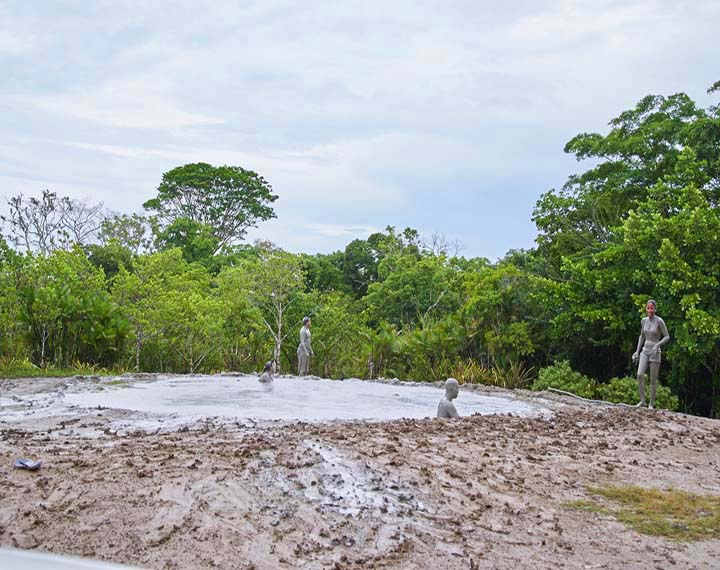
Have you visited the L’eau Michel Mud Volcano and felt the sensation of floating in that pool of mud and wondered, what is a mud volcano exactly? Or perhaps you have seen photos and wondered how they are made and where the mud is coming from? Well, according to The University of the West Indies (UWI) Seismic Research Centre, mud volcanoes are not actually real volcanoes at all. They are vents or fractures through which warm mud is emitted and are not as hazardous as real volcanoes (The UWI Seismic Research Centre).
Mud volcanoes require the leakage of natural gas from deep in the ground to the surface. When the gas is mixed with salt water, and a relatively soft clay type soil, the mud if formed. These geological features have little in common with real volcanoes which are on a much larger scale with very high-temperature molten rock or magma emanating from deep within the earth and reaching the surface as lava and which can be highly destructive.
While Trinidad is not a volcanic island, it has the ideal unique conditions for the creation and maintenance of mud volcanoes. Mud volcanoes “are generally encountered in areas where natural gas is present” (The UWI Seismic Research Centre). Trinidad has no less than 18 mud volcanoes which are located mainly in the southern half of the island in areas such as Tabaquite, Piparo, Princes Town and even the Nariva Swamp (Barr and Bolli, 1953). Interestingly, the south-western peninsula of Trinidad is littered with them, but there are no mud volcanoes in Tobago.
In Trinidad, while mud volcanoes are an interesting and mystical natural feature, they can also be strongly linked to our intangible cultural heritage. The Balka Devi Mud Volcano of the L’Envieusse mud volcanoes is one example. Here the Mother Balka or Balka Devi is revered and worshipped as a Goddess by Hindus (de Silva 2019). At the site there is a Mandir on the edge of the mud volcano and each year it brings Hindus in pilgrimage for a Balka Devi Festival under the auspices of the Hindu Festival Society. “Balka Devi Puja seeks to restore equilibrium in the inner earth so that people could be protected from the violent effects of earthquakes, volcanic eruptions, tsunamis, and fires” (de Silva 2019).
The site is open to visitors via bookings and the National Trust has conducted public tours to the mud volcano where curious patrons were able to touch the mud, discuss the religious significance of the site with the devotees, and contribute to the maintenance of the property. There are many more mud volcanoes in the L’Envieusse, Columbia Estate, San Quintin Estate and Cedros areas. These distinctive features of our landscape are part of Trinidad’s Geoheritage.



 Own or work here?