

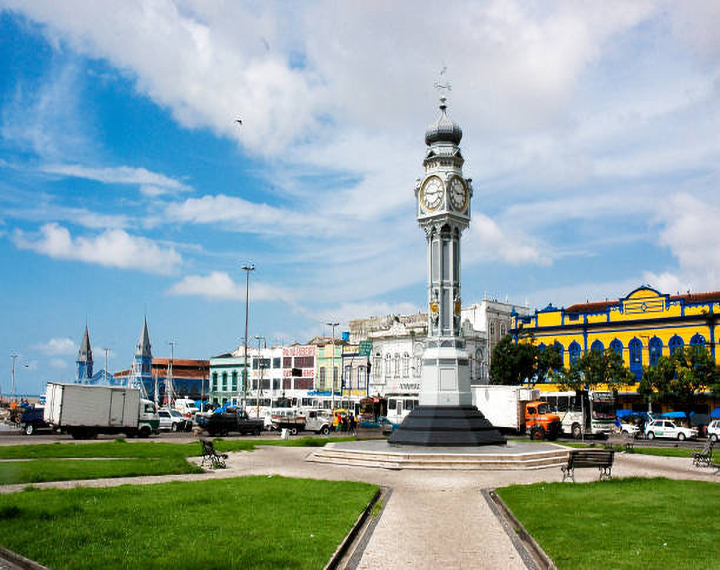
Praça do Relógio, also known as Praça Siqueira Campos, is one of Belém’s most iconic historic squares, situated near the Doca do Ver-o-Peso in the Cidade Velha neighborhood. Established in 1931 to honor Lieutenant Siqueira Campos, a hero of the 1922 Revolt of the Lash, the square has become both a cultural landmark and a central gathering place for locals and visitors. Its location on the site of the former Embocadura do Igarapé do Piri adds an additional layer of historical significance, linking the square to the broader development of Belém over the centuries.
The centerpiece of the square is a 12-meter-high iron clock tower, constructed by the English company J.W. Benson and gifted by Intendant Antonio Faciola. Surrounding the tower are four ornate iron lampposts, crafted by Macfarlane in 1893, which contribute to the square’s historical charm. The square spans over 2,700 square meters, with a carefully balanced combination of paved areas and green spaces, offering a functional yet aesthetically pleasing public environment. The design successfully blends historical tribute with practical urban utility, making it both a visual focal point and a welcoming social space.
Over the years, Praça do Relógio has undergone several restorations to preserve its integrity and ensure the clock’s proper functioning. Notably, the clock was repaired in 1988, and the square received fresh paintwork on both the tower and lampposts in 1994. These efforts have maintained the square’s prominence in Belém’s social and cultural life. Its proximity to other historic sites, such as the Ver-o-Peso Market and Dom Pedro II Square, further cements its role as a hub of cultural activity.
Today, Praça do Relógio continues to attract both residents and tourists, offering a peaceful spot to relax while exploring Belém’s historic center. Visitors can admire the architectural details, reflect on the city’s rich history, and use the square as a gateway to nearby attractions. More than just a public space, the square serves as a living monument to Belém’s heritage, symbolizing the passage of time while celebrating the city’s enduring cultural legacy.



 Own or work here?