

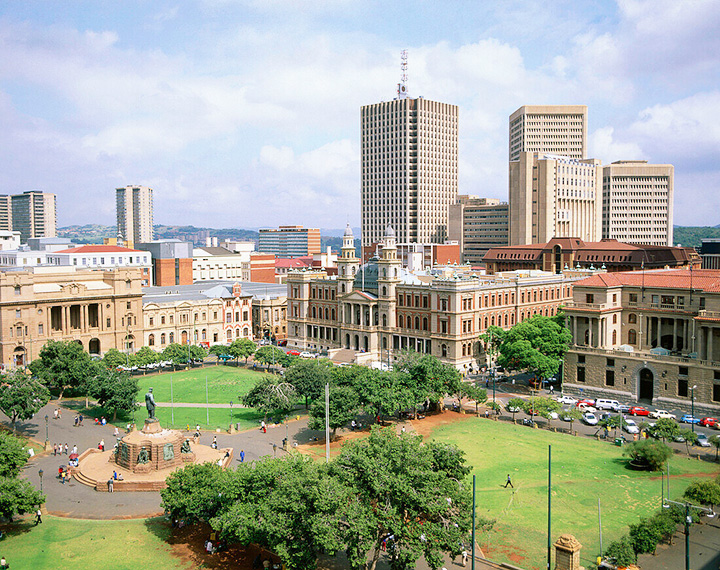
Church Square in Pretoria is a historic and vibrant heart of the city, a place where South Africa’s past and present meet in a beautifully framed public space. At its centre stands the grand **Pretoria City Hall and the Old Raadsaal**, surrounded by statues, fountains, and historic buildings that tell stories of the city’s founding and growth. The square’s blend of architecture — from colonial to neoclassical — makes it a visual feast for visitors and a natural gathering point for locals and tourists alike. Church Square is the historic core of Pretoria, originally laid out by the city’s founder, Marthinus Pretorius, as both a market place and a churchyard. Over time, three different church buildings stood in the square between 1856 and 1905, giving the square its name. The square has witnessed major moments in South African history, not least the funeral of former president Paul Kruger, which was held at the last of those churches before it was demolished.
At the center of Church Square now stands a large bronze statue of Paul Kruger, sculpted by Anton van Wouw on commission from industrialist Sammy Marks. He is flanked by four statues of anonymous Boer citizen-soldiers. The square is surrounded by a number of architecturally and historically significant buildings: the Palace of Justice (site of the infamous Rivonia Trial), the Old Capitol Theatre, Tudor Chambers, the Ou Raadsaal (Old Council Chamber), and the General Post Office designed by William Hawke. Over the years, Church Square has gone through a restoration and rejuvenation project to emphasize its heritage value while making it more welcoming to visitors. The square has also retained a charm that makes it a peaceful gathering spot, with benches under trees where locals, tourists, and students often sit and reflect.
In its earlier years, Pretoria Station was linked to Church Square by horse-drawn trams, and later by electric trams after 1910. The station has played a vital role in Pretoria’s transport history, and it remains a key rail hub: it serves commuter lines, and even the iconic luxury Blue Train has one of its endpoints here. Historically, Church Square was more than a marketplace; it was also a social and political hub. Together, Pretoria Station and Church Square anchor the city’s historic centre, serving as living monuments to the architectural, political, and cultural legacy of Pretoria.
Strolling through Church Square, you are immediately struck by its sense of history and culture. Statues of notable figures, including **Paul Kruger**, commemorate South Africa’s heritage, while the surrounding streets are lined with shops, cafés, and galleries that give the area a lively, contemporary energy. Guided walks often highlight the square’s role in Pretoria’s development, making it both an educational and inspiring stop. Church Square is also a hub for events, from markets and cultural celebrations to political rallies and music performances. Visitors can pause to enjoy the architecture, people-watch, or relax under shady trees while appreciating the vibrant life around them. With its combination of history, culture, and daily urban rhythm, Church Square offers a rich, inviting glimpse into Pretoria’s soul and the enduring spirit of its community.



 Own or work here?