

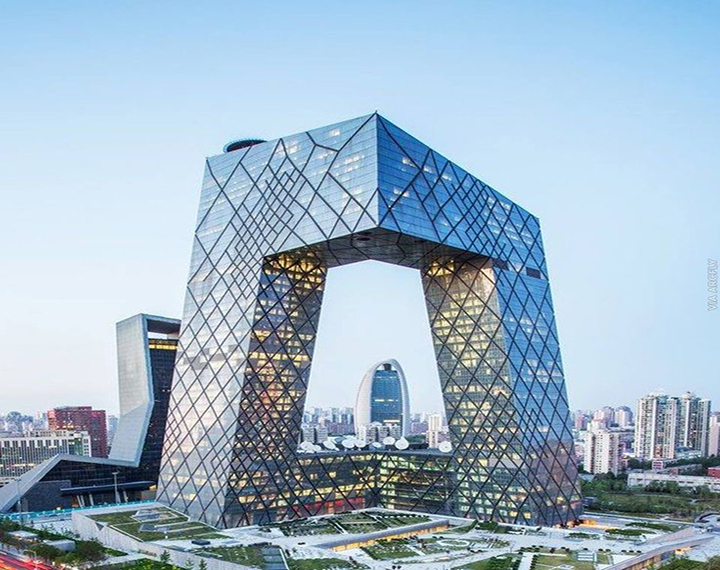
The CCTV Headquarters in Beijing stands as one of the most striking architectural symbols of modern China, reflecting the country’s ambition, innovation, and evolving identity in the global age. Designed by the renowned Dutch architect Rem Koolhaas and German architect Ole Scheeren, the building defies conventional skyscraper design with its daring loop structure — two leaning towers connected at the top and bottom to form a continuous geometric figure. Completed in 2012, it immediately became an icon of twenty-first-century Beijing, representing both the creative confidence of a nation on the rise and the architectural boldness that has come to define the city’s skyline. Its location in the bustling Central Business District amplifies its presence as a centerpiece of contemporary Beijing, surrounded by shimmering towers that together signal the city’s transformation into a world capital.
Culturally and symbolically, the CCTV Headquarters embodies more than architectural innovation; it stands at the crossroads of China’s media evolution. As the home of China Central Television, the country’s national broadcaster, it is the nerve centre of information, storytelling, and cultural production, influencing how millions of people perceive China and the world. Its unusual shape — often described as a “Z crisscrossing the sky” — is seen by some as a metaphor for China’s complex and interconnected narrative: traditional yet modern, rooted yet forward-looking. The building’s very form challenges the vertical uniformity of the skyscraper, symbolizing a new way of thinking that embraces creativity while maintaining structure and purpose.
For tourists, the CCTV Headquarters is both a visual marvel and a cultural landmark. Its bold silhouette, particularly striking at sunrise or under evening lights, draws photographers and architecture enthusiasts from around the world. While the building itself is not generally open for public tours, the surrounding plaza and business district offer excellent views and an opportunity to reflect on Beijing’s transformation from an imperial capital to a city of global influence. Standing before it, one senses the city’s dual heartbeat — the ancient and the futuristic — and the powerful narrative of a nation expressing its modern identity through art, engineering, and vision.



 Own or work here?