

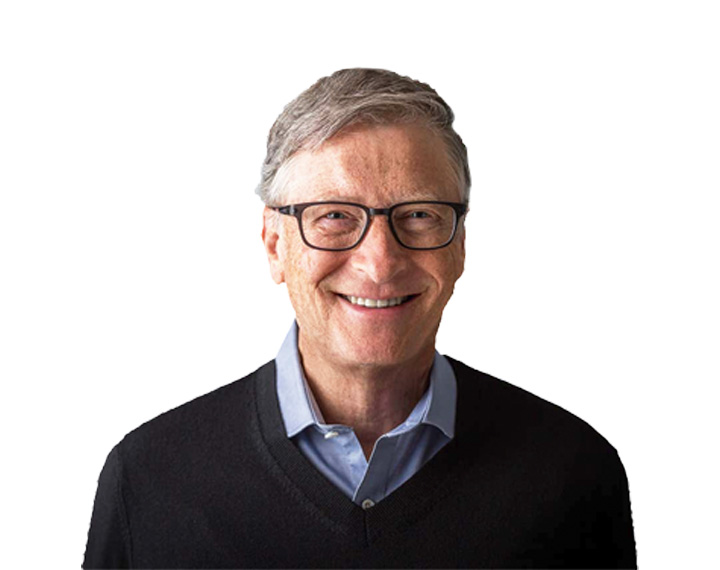
Bill Gates is a visionary thinker, a tireless problem-solver, and one of the most transformative figures of the modern era. Born in Seattle in 1955, he showed an early passion for computers and an insatiable curiosity for how technology could improve life. That passion ignited a revolution. As co-founder of Microsoft, he helped usher in the personal-computing age, empowering millions of people and businesses around the world, and fundamentally reshaping how humanity learns, works, and connects. His journey from a college dropout to one of history’s most successful innovators stands as a powerful testament to imagination, grit, and the courage to believe in ideas before others see them.
Yet Bill Gates’ legacy extends far beyond technology. Driven by a deep belief that every life has equal value, he turned his focus from innovation to impact, dedicating his resources and energy to global health, education, and development. Through the Bill & Melinda Gates Foundation, he has championed the fight against disease, poverty, and inequality, backed ambitious scientific research, and helped provide life-saving vaccines and education opportunities to communities worldwide. His commitment shows that true success is not measured by wealth or invention alone, but by the difference one makes in the lives of others.
Today, Gates remains a beacon of forward-thinking leadership — advocating for sustainable energy, pandemic preparedness, and a future where innovation lifts every community. His story reminds us that knowledge fuels progress, compassion drives purpose, and one determined individual truly can change the world. He inspires dreamers, entrepreneurs, and global citizens alike to think boldly, act courageously, and work tirelessly toward a better tomorrow — proving that with vision and heart, extraordinary impact is possible.
We typically hear about two sectors, the public and the private. The private sector—business—is good at developing products and services, while the public sector—government—is good at delivering solutions to all the people who need them.
In many cases, the private and public sectors, acting either separately or together, meet people’s needs. But there are gaps, spaces where some people don’t get what they need to live healthy, productive lives.
Here’s an example: A generation ago, the market for vaccines worked well in wealthy countries—if you wanted to be immunized against a whole range of diseases, you could—but the system did not work for other parts of the world. Certain vaccines just weren’t available for most people. The private sector didn’t sell them in low-income countries because it wasn’t clear there would be buyers. Governments tried to step in, but they weren’t in a position to bring all the pieces—the funding, the partnerships, the logistics—together to make it work. Tragically, millions of children were dying of preventable diseases each year.
This is the kind of problem that philanthropies can help solve, and it’s how we define our foundation’s role. How do we actually help solve problems? What does our foundation do specifically?



 Own or work here?