

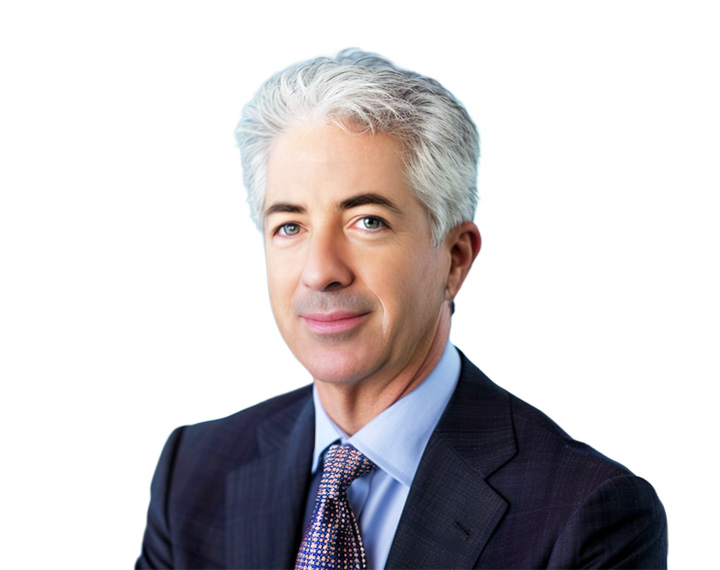
William “Bill” Ackman was born in Chappaqua, New York, in 1966, into a family with deep ties to real estate and finance. From a young age, he showed intellectual curiosity and ambition, eventually earning a Bachelor of Arts (magna cum laude) from Harvard College and later an MBA from Harvard Business School.
In 2003, Ackman took a bold step and founded Pershing Square Capital Management, launching it with a concentrated, research-driven investment philosophy. Rather than chasing diversification, he doubled down on a few high-conviction positions, believing deeply in the power of active, thoughtful engagement to drive change and create value. His approach is not just about financial returns—it’s about influencing the companies he invests in, pushing for better governance, structure, and long-term performance.
Ackman has never shied away from risk or controversy. One of his most public battles came when he famously shorted Herbalife, calling it a pyramid scheme—an audacious and polarizing move that earned both critics and respect. And yet, even when his fund suffered major setbacks (like heavy losses in the mid-2010s), he doubled down on learning, recalibration, and resilience.
Bill’s leadership shone brightest during the COVID-19 crisis. In early 2020, he made a prescient move: he hedged his portfolio by buying credit protection, spending “only” $27 million to potentially protect billions. When markets crashed, that bet paid off in a huge way—generating $2.6 billion, a testament to his courage, conviction, and deep analysis.
But Ackman is not just a profit-seeking investor. In 2006, he co-founded the Pershing Square Foundation, a philanthropic vehicle dedicated to supporting visionary leaders working on societal, environmental, and health problems. He also serves on the Investor Advisory Committee of the Federal Reserve Bank of New York and is deeply involved in education, serving on the Board of Dean’s Advisors at Harvard Business School.
What makes Bill Ackman truly inspiring is how he blends activism, humility, and long-term thinking. He sees investing not just as a way to make money, but as a tool to effect positive change. His story shows that real impact comes from doing deep work, staying committed even in the face of failure, and giving back. Despite enormous pressures, he remains a powerful example of what it means to lead with vision—and to bet on bold ideas that others sometimes fear to touch.
Pershing Square Holdings, Ltd. (“PSH”, or the “Company”) (LN:PSH) (LN:PSHD) is an investment holding company structured as a closed-ended fund principally engaged in the business of acquiring and holding significant (but generally not controlling) positions in a concentrated number of large capitalization companies. PSH’s objective is to maximize its long-term compound annual rate of growth in intrinsic value per share.
PSH was incorporated with limited liability under the laws of the Bailiwick of Guernsey on February 2, 2012. It commenced operations on December 31, 2012 as a registered open-ended investment scheme, and on October 2, 2014 converted into a registered closed-ended investment scheme. Public Shares of PSH commenced trading on Euronext Amsterdam N.V. on October 13, 2014. On May 2, 2017, PSH’s Public Shares were admitted to the Official List of the UK Listing Authority and commenced trading on the Premium Segment of the Main Market of the London Stock Exchange(“LSE”). PSH delisted from Euronext Amsterdam with effect from 31 January 2025.
PSH has appointed Pershing Square Capital Management, L.P. (“PSCM,” the “Investment Manager” or “Pershing Square”),as its investment manager. PSCM was founded by William A. Ackman on January 1, 2004. The Investment Manager has responsibility, subject to the overall supervision of the Board of Directors, for the investment of PSH’s assets and liabilities in accordance with the investment policy of PSH.
The substantial majority of the Company’s portfolio is typically allocated to 8 to 12 core holdings usually comprising liquid, listed large capitalization North American companies. The Investment Manager generally focuses on high-quality businesses, which it believes have limited downside and that generate predictable, recurring cash flow, and in certain cases seeks to catalyze managerial, operating and governance changes as levers to create substantial, enduring and long-term shareholder value. The Investment Manager aims to manage risks through careful investment selection and portfolio construction, engaging in typically only one to three new core investments each year. The Investment Manager may also engage in hedging strategies to mitigate market-related downside risk or to take advantage of asymmetric profit opportunities.



 Own or work here?