

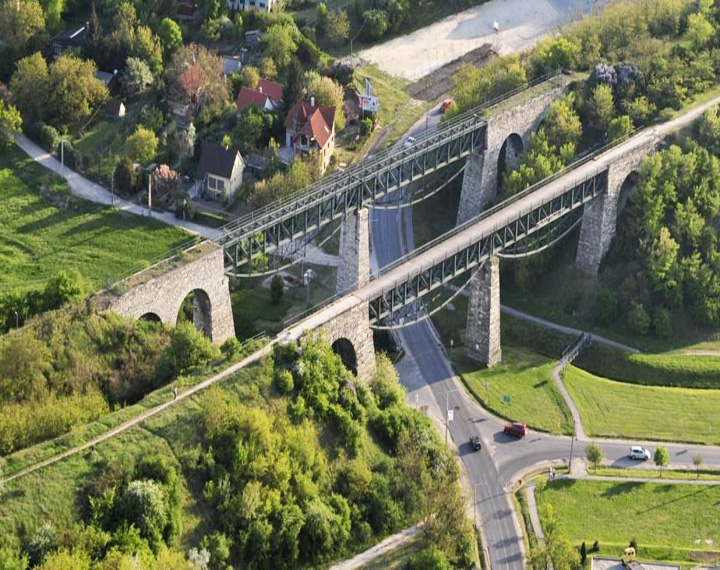
The Biatorbágy Railway Viaduct stands with its majestic double arches as one of the most poignant mementos of Hungarian railway history and architectural genius. Once a vital segment of the main line connecting Budapest to Vienna, this monumental valley bridge no longer echoes with the clatter of trains but instead welcomes curious hikers who come to admire the rolling hills of the Zsámbék Basin from its heights. The meeting of robust stone structures and airy spans provides a visual experience that simultaneously evokes the momentum of the nineteenth-century Industrial Revolution and the quiet serenity of the nature that has since reclaimed the valley.
Culturally, the name of the viaduct is inextricably linked to one of the darkest and best-known events in Hungarian history: the 1031 train bombing. The act committed by Szilveszter Matuska drew international attention to this site, and although the memory of the tragedy still haunts the stones, the bridge has since become a symbol of remembrance and renewal. This duality—engineering beauty coupled with historical drama—gives the location a unique, slightly melancholic, yet uplifting atmosphere that has inspired writers, film directors, and historians alike throughout the decades.
The history of the bridge stretches back to the 1880s, when the transport needs of the dynamically developing Austro-Hungarian Monarchy called the two parallel structures into existence. Although railway traffic was moved to a new route in the 1970s, the viaduct was not left to decay; thanks to the cooperation of the local community and monument protection services, it now functions as a scenic walkway. The restored walls and secure railings allow visitors to literally walk above the past, feeling the weight of former steam locomotives and the unparalleled precision of the era’s master builders.
For tourists, this landmark of Biatorbágy is a mandatory stop, as it is located just a short drive or train ride from Budapest, making it a perfect destination for an afternoon excursion. The panorama opening from the top of the bridge is particularly stunning at sunset, when the light bathes the landscape and the town’s houses in gold. Nearby hiking trails, such as the paths of the Iharos Forest, offer further opportunities for nature lovers to admire the viaduct from different perspectives, including from the valley floor, where its truly commanding dimensions can be fully appreciated.
Walking across the viaduct, one can almost hear the echoes of bygone eras while the vibrancy of modern Biatorbágy unfolds beneath one’s feet. Information plaques placed at the foot of the bridge assist in understanding the historical context, while nearby cozy confectioneries and restaurants provide physical refreshment after the intellectual adventure. This site is not merely a structure but an emotional bridge between the past and the present, reminding every visitor that human creativity can prove more enduring than the storms of the most difficult times.



 Own or work here?