
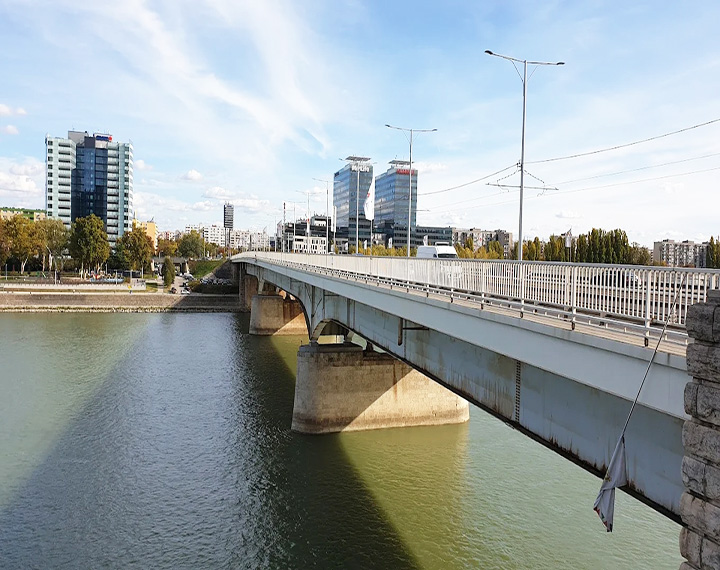
The second longest and one of the most vital river crossings in Budapest, serving as a majestic northern gateway over the Danube. It radiates an atmosphere of industrious energy and modern resilience, stretching nearly a kilometer to connect the bustling Thirteenth District with the historic charm of the Third District. This inviting thoroughfare offers an uplifting perspective for travelers, providing a unique vantage point where the sprawling urban skyline meets the verdant, peaceful northern tip of Margaret Island and the natural beauty of the river’s flow.
The bridge acts as a significant cultural and transit artery, facilitating a spirited dialogue between the commercial centers of Pest and the tranquil residential hills of Buda. The experience of crossing it is defined by a sense of vastness and momentum, as it carries a dedicated tram line, multiple traffic lanes, and wide bicycle paths that encourage a healthy, active lifestyle for the city’s residents. By serving as a primary access point to the recreational heart of the capital, the bridge motivates thousands of people every day to seek out the green sanctuary of the island for sport, music, and communal relaxation.
Spans approximately 928 meters in length, making it a monumental feat of mid-20th-century Hungarian engineering and steel construction. Features a direct descent onto the northern end of Margaret Island, allowing visitors to enter the parkland from a less crowded and more serene direction. Offers a wide-angle view of the Hajógyári Island to the north, which is the legendary home of the internationally acclaimed Sziget Festival. The pedestrian walkways are particularly popular at twilight, providing an inspiring and uncrowded spot to witness the city lights reflecting off the expansive northern Danube.
Historically, the construction of the bridge was a resilient journey that began in 1939 but was significantly delayed by the events of World War II. It was finally opened in 1950 and originally named Stalin Bridge before being renamed in 1958 to honor Árpád, the Grand Prince of the Hungarians who led the tribes into the Carpathian Basin in the 9th century. The structure underwent a massive widening and modernization project in the 1980s, successfully evolving into the high-capacity, multi-modal masterpiece that remains a beautiful and steadfast pillar of the city’s contemporary infrastructure.
Tourists and locals find the Árpád Bridge to be an inspiring highlight of the city’s northern landscape, bridging the gap between the ultra-modern office towers of Váci Road and the ruins of the Roman city of Aquincum. Its location provides an informative look at the city’s northern development, offering a beautiful and motivating sense of the capital’s scale and its future-oriented vision. Walking across this steel giant provides a profound sense of connection to the city’s industrious spirit, leaving every visitor with an uplifting memory of the rhythmic beauty and enduring strength that define the modern character of Budapest.



 Own or work here?